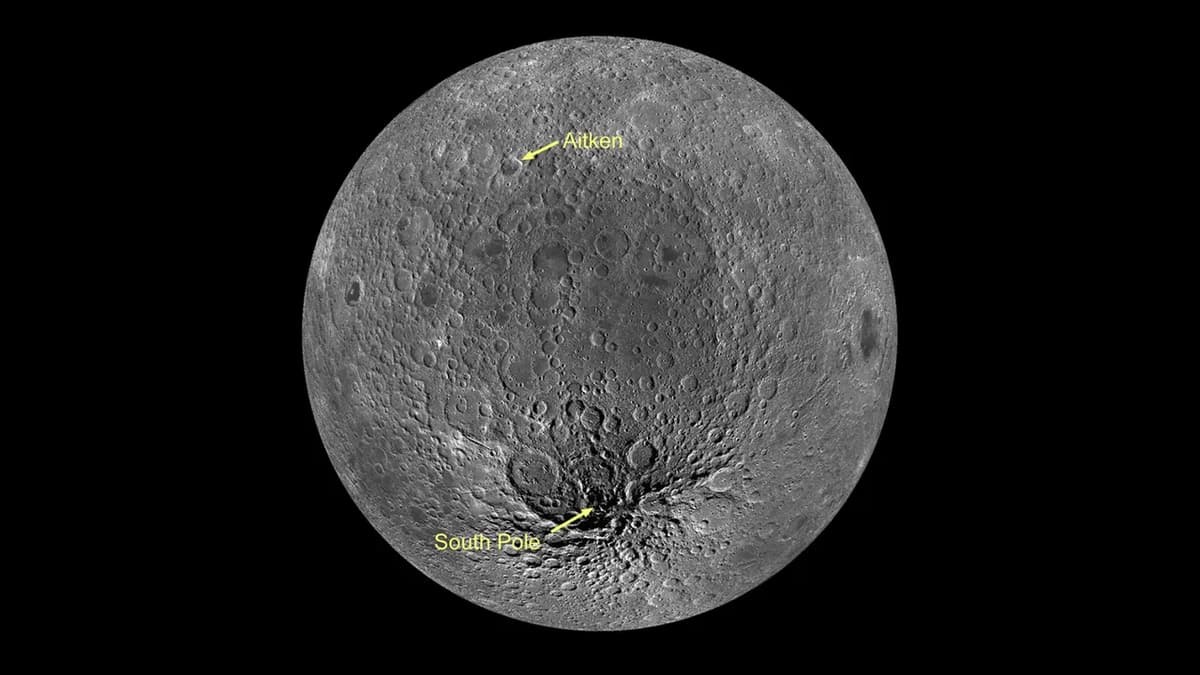
A Bizarre 'Decapitated' Asteroid Likely Made the Moon's Largest Impact Crater. NASA's Artemis Astronauts May Land Near the Proof
Why It Matters
The finding links a specific impact scenario to the Moon’s largest basin, offering a concrete target for Artemis sample‑return and advancing our understanding of planetary formation processes.
Key Takeaways
- •SPA basin spans ~2,000 km, exposing deep mantle material
- •Differentiated 260‑km asteroid ‘decapitated’ at 30° impact angle
- •Ejecta may deposit mantle rocks near the lunar south pole
- •Artemis IV could retrieve samples to date SPA and probe interior
Pulse Analysis
The South Pole–Aitken (SPA) basin, a 2,000‑kilometer-wide scar on the Moon’s far side, has long been a focal point for scientists seeking clues about the lunar mantle. Recent 3‑D impact modeling suggests the basin’s distinctive tapered‑ellipse shape resulted from a differentiated asteroid—one that had already separated into a dense iron core and a rocky mantle—colliding at a shallow 30‑degree angle. This ‘decapitation’ scenario explains why the basin is not circular, distinguishing it from impacts by undifferentiated bodies.
For NASA’s Artemis program, the study carries practical implications. The simulated impact flung deep‑origin ejecta toward the lunar south pole, precisely where Artemis IV astronauts plan to touch down after 2028. Sampling this material could provide the first direct access to mantle fragments, allowing researchers to determine the SPA’s formation age and refine models of the Moon’s thermal and chemical evolution. Such data would fill a critical gap in our knowledge of how the Earth‑Moon system cooled after the giant impact that created the Moon.
Beyond lunar science, the research reshapes how planetary scientists interpret large impact basins across the solar system. Recognizing that differentiated impactors can produce asymmetric craters may prompt re‑examination of features on Mars, Mercury, and even Earth’s ancient basins. Moreover, the prospect of retrieving mantle material fuels commercial interest in lunar resource utilization, as deep‑origin rocks could harbor rare minerals. As Artemis missions progress, the SPA basin stands as a natural laboratory linking impact dynamics, planetary interiors, and future exploration economics.
A bizarre 'decapitated' asteroid likely made the moon's largest impact crater. NASA's Artemis astronauts may land near the proof
Comments
Want to join the conversation?
Loading comments...