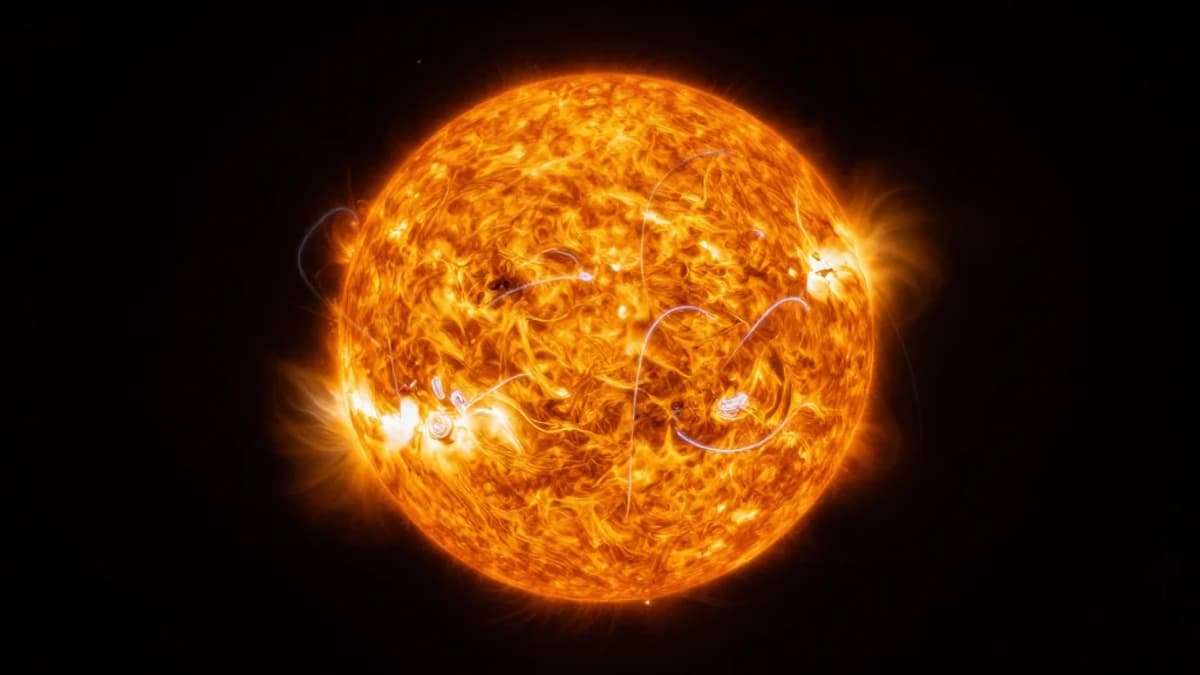
A Century's Worth of Data Could Help Predict Future Solar Cycle Activity
•January 20, 2026
0
Why It Matters
Accurate long‑term solar activity forecasts protect satellites, power grids, and deep‑space missions from disruptive space‑weather events, making this century‑scale data breakthrough critical for the aerospace and communications sectors.
Key Takeaways
- •Century-long Ca II K data calibrated to modern standards
- •Polar magnetic field proxy enables longer solar cycle forecasts
- •Algorithm automates analysis of 50,000 historic solar images
- •Predictions could extend beyond current five‑year horizon
- •Proposed polar mission aims for direct magnetic observations
Pulse Analysis
Understanding the Sun’s 11‑year cycle has long been hampered by the scarcity of direct polar magnetic measurements, which only began in the 1970s. Researchers therefore turn to indirect proxies, and the chromospheric Ca II K line offers a unique window into magnetic activity. By leveraging more than a hundred years of observations from the Kodaikanal Solar Observatory, scientists can fill the historical gap and build a continuous picture of the Sun’s polar fields, a key driver of future cycles.
The breakthrough came from meticulous data hygiene: time‑zone slips, rotation errors, and instrument drift were corrected to align the early plates with contemporary space‑based magnetograms. An automated algorithm then scanned roughly 50,000 images, extracting brightness patterns that correlate with magnetic polarity. This proxy, dubbed the Ca II K Polar Network Index, has already demonstrated the ability to forecast solar activity several years ahead, surpassing the five‑year horizon that current models achieve. The methodology not only validates the scientific premise but also offers a scalable framework for other historic solar archives.
For industry, the implications are tangible. More reliable long‑term solar forecasts enable satellite operators, power‑grid managers, and mission planners to anticipate space‑weather risks well before launch windows or critical infrastructure deployments. The team’s proposal for a dedicated solar‑polar mission would provide continuous, high‑resolution magnetic data, further sharpening predictive models. As the commercial space sector expands, integrating century‑scale solar insights into risk‑assessment tools will become a competitive advantage, safeguarding assets against the Sun’s volatile temperament.
A century's worth of data could help predict future solar cycle activity
0
Comments
Want to join the conversation?
Loading comments...