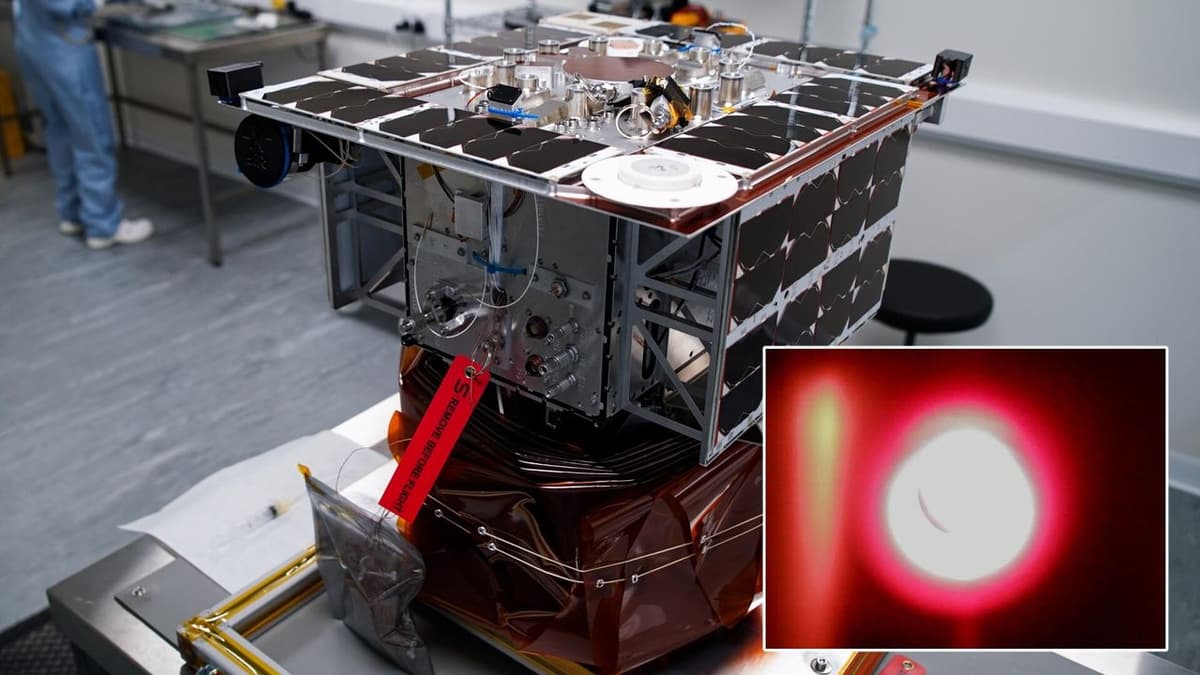
'A Completely New Manufacturing Frontier': Space Forge Fires up 1st Commercial Semiconductor Factory in Space
•January 11, 2026
0
Companies Mentioned


Why It Matters
Demonstrating controllable plasma in space unlocks a new manufacturing paradigm that could dramatically improve semiconductor performance and energy efficiency, reshaping electronics and telecom markets.
Key Takeaways
- •Space Forge generated plasma aboard ForgeStar-1, first commercial satellite
- •Plasma enables crystal growth for space‑based semiconductor production
- •Weightlessness could improve semiconductor efficiency up to 60 %
- •ForgeStar-2 will return manufactured chips to Earth via heat shield
- •Series A raised £22.6 million to fund next orbital factory
Pulse Analysis
In‑orbit manufacturing has long been a theoretical frontier, constrained by the high cost and limited capacity of the International Space Station. Space Forge’s breakthrough with ForgeStar‑1 demonstrates that a dedicated, free‑flying satellite can host the extreme thermal environments required for semiconductor crystal growth. By miniaturising a furnace to fit a microwave‑oven‑sized bus, the company sidesteps the logistical bottlenecks of ISS payloads, opening a scalable pathway for continuous production in microgravity.
The plasma generated at roughly 1,000 °C creates a pristine gas‑phase environment where atoms can arrange without the convective disturbances present on Earth. This results in crystals with fewer defects, enabling semiconductors—particularly wide‑bandgap materials like gallium nitride and silicon carbide—to achieve higher electron mobility and thermal conductivity. Such material improvements translate directly into lower power draw for processors, power‑amplifiers, and next‑generation communication devices, potentially slashing energy usage by up to 60 % compared with terrestrial counterparts.
Commercially, the successful demonstration validates Space Forge’s business model and justifies its £22.6 million Series A round. The forthcoming ForgeStar‑2 will not only produce a batch of space‑grown chips but also return them safely, establishing a full‑cycle supply chain from orbit to market. If the performance gains hold, manufacturers could adopt space‑fabricated components for high‑end applications, prompting a shift in semiconductor sourcing strategies and stimulating further investment in orbital factories across the aerospace and electronics sectors.
'A completely new manufacturing frontier': Space Forge fires up 1st commercial semiconductor factory in space
0
Comments
Want to join the conversation?
Loading comments...