A Guide to In-Space Electric Propulsion: Manufacturers and Products
•January 24, 2026
0


Why It Matters
EP is the propulsion backbone that makes large satellite constellations economically viable and expands deep‑space exploration, reshaping the space economy.
Key Takeaways
- •EP offers 1,500‑10,000 s specific impulse, saving mass.
- •Hall thrusters dominate commercial GEO and LEO satellites.
- •Startups drive propellant innovation: krypton, iodine, water.
- •Space‑tug services create new “last‑mile” revenue streams.
Pulse Analysis
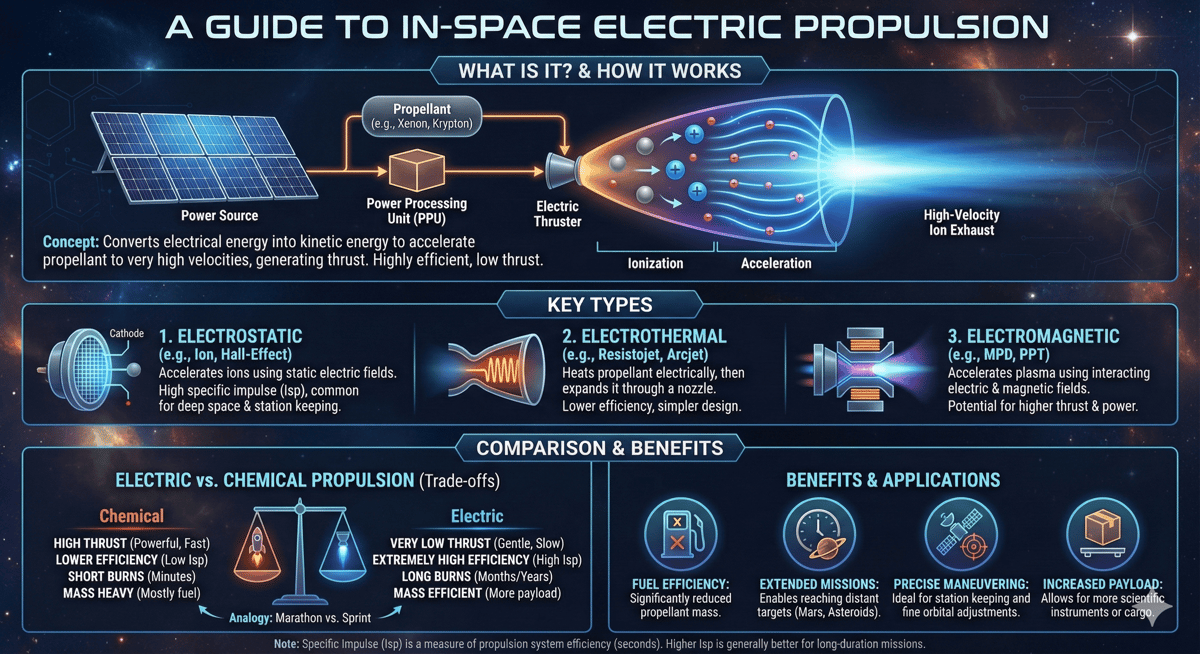
Electric propulsion has reshaped how spacecraft maneuver once they leave Earth’s gravity well. By ionizing a lightweight propellant such as xenon, krypton, or iodine and accelerating the ions with electric and magnetic fields, EP thrusters achieve specific impulses between 1,500 and 10,000 seconds—orders of magnitude higher than chemical rockets. This efficiency translates into dramatically lower propellant mass, allowing launch vehicles to carry larger payloads or reduce launch costs. Although thrust levels are modest, the continuous low‑force push accumulates over weeks or months, enabling precise orbit‑raising, station‑keeping, and deep‑space trajectories that would be prohibitive with traditional propulsion.
The commercial surge in low‑Earth‑orbit constellations has turned EP from a niche technology into an industry cornerstone. Established aerospace firms such as Aerojet Rocketdyne, Safran, and Thales Alenia supply high‑power Hall and gridded ion thrusters for GEO platforms, while a new generation of startups—Busek, Exotrail, ThrustMe, Momentus, and Phase Four—focus on miniaturized Hall, electrospray, and microwave plasma designs tailored to CubeSats and rideshare payloads. Mass‑production lines are emerging to meet the demand for thousands of identical thrusters, and space‑tug services are leveraging these engines to deliver satellites from a common drop‑off point to their final orbits.
Looking ahead, the propulsion market is diversifying beyond xenon toward cheaper, safer propellants such as krypton, solid iodine, and even water, each unlocking new cost‑structures and mission profiles. High‑power concepts like VASIMR and advanced Hall designs promise megawatt‑scale thrust for lunar gateways and Mars transfer vehicles, while low‑thrust electrospray chips enable ultra‑precise attitude control for large constellations. These technological advances, combined with a vibrant ecosystem of manufacturers and service providers, are lowering barriers to entry, extending satellite lifespans, and fueling a permanent, mobile economy in space.
A Guide to In-Space Electric Propulsion: Manufacturers and Products
0
Comments
Want to join the conversation?
Loading comments...