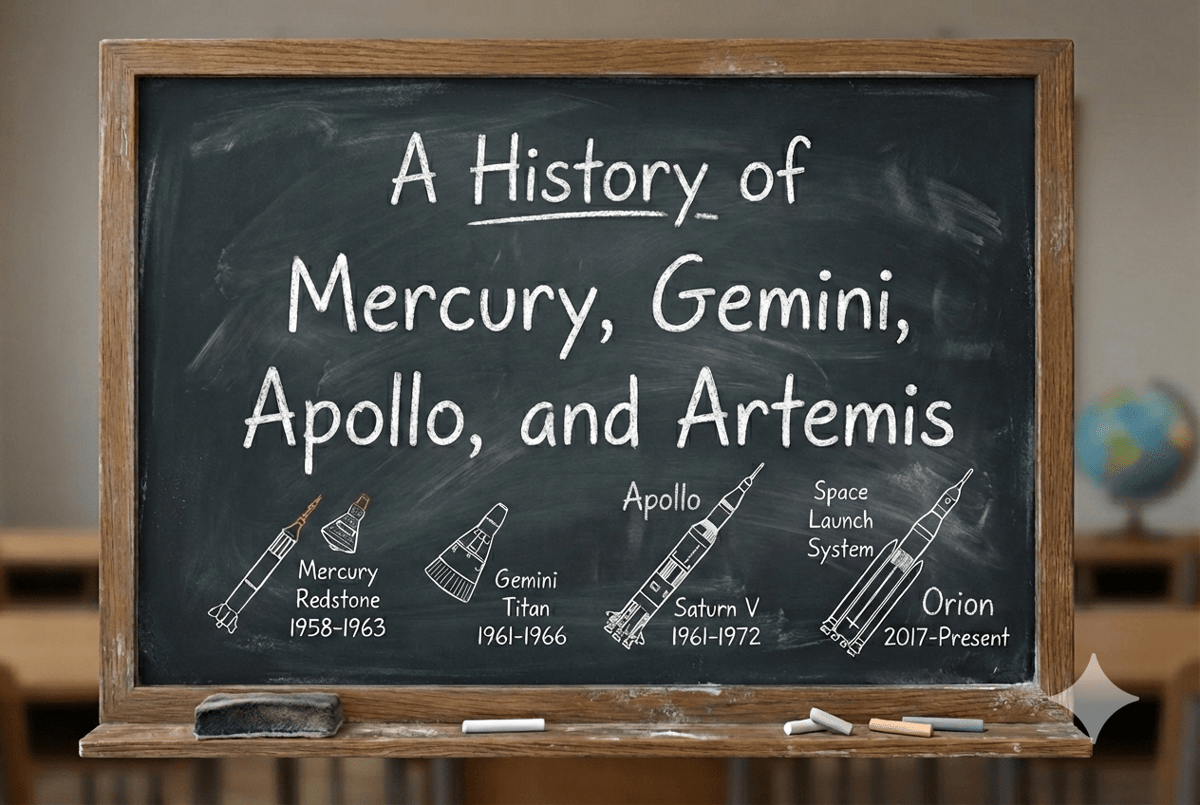
A History of Mercury, Gemini, Apollo, and Artemis
•February 19, 2026
0
Why It Matters
The evolution from Mercury to Artemis shows how NASA’s shifting strategies—from government‑only programs to commercial and multinational partnerships—are reshaping the economics and feasibility of deep‑space exploration, directly influencing future missions to Mars and beyond.
Key Takeaways
- •Mercury proved human orbital survival and recovery techniques.
- •Gemini established rendezvous, docking, EVA, and long‑duration flight.
- •Apollo achieved six Moon landings and scientific breakthroughs.
- •Artemis targets sustainable lunar presence using commercial and international partners.
- •Artemis Accords guide responsible space behavior for over 40 nations.
Pulse Analysis
The Cold War ignited a geopolitical race that forced the United States to create NASA and launch Project Mercury. Beyond the political drama, Mercury’s modest 15‑minute flights validated core human‑spaceflight systems—launch escape, re‑entry heat shields, and global tracking—that became the backbone of every subsequent program. By proving that a person could survive in orbit, Mercury turned spaceflight from a speculative concept into a disciplined engineering enterprise.
Gemini built on that foundation, turning short hops into multi‑day missions that mastered orbital rendezvous, docking, and the first American spacewalks. Those capabilities were not merely technical milestones; they were the essential choreography for a lunar landing. Apollo’s massive Saturn V rockets and lunar‑module architecture turned the abstract goal of “a man on the Moon” into reality, delivering 382 kg of lunar material and spawning civilian technologies ranging from memory foam to advanced integrated circuits. The program also reshaped public perception, embedding the image of Earth as a fragile oasis—a narrative that continues to influence environmental policy.
Artemis represents a paradigm shift, moving from a solely government‑funded model to a hybrid that blends NASA’s deep‑space expertise with commercial innovators like SpaceX and Blue Origin. The program’s emphasis on a sustainable lunar economy—leveraging water‑ice for fuel, establishing the Gateway as a logistics hub, and signing the Artemis Accords with over 40 nations—creates a reusable infrastructure that can support longer stays and serve as a launchpad for Mars. By integrating international partners and private sector agility, Artemis aims to reduce costs, accelerate technology development, and ensure that humanity’s next giant leap is both economically viable and globally inclusive.
A History of Mercury, Gemini, Apollo, and Artemis
0
Comments
Want to join the conversation?
Loading comments...