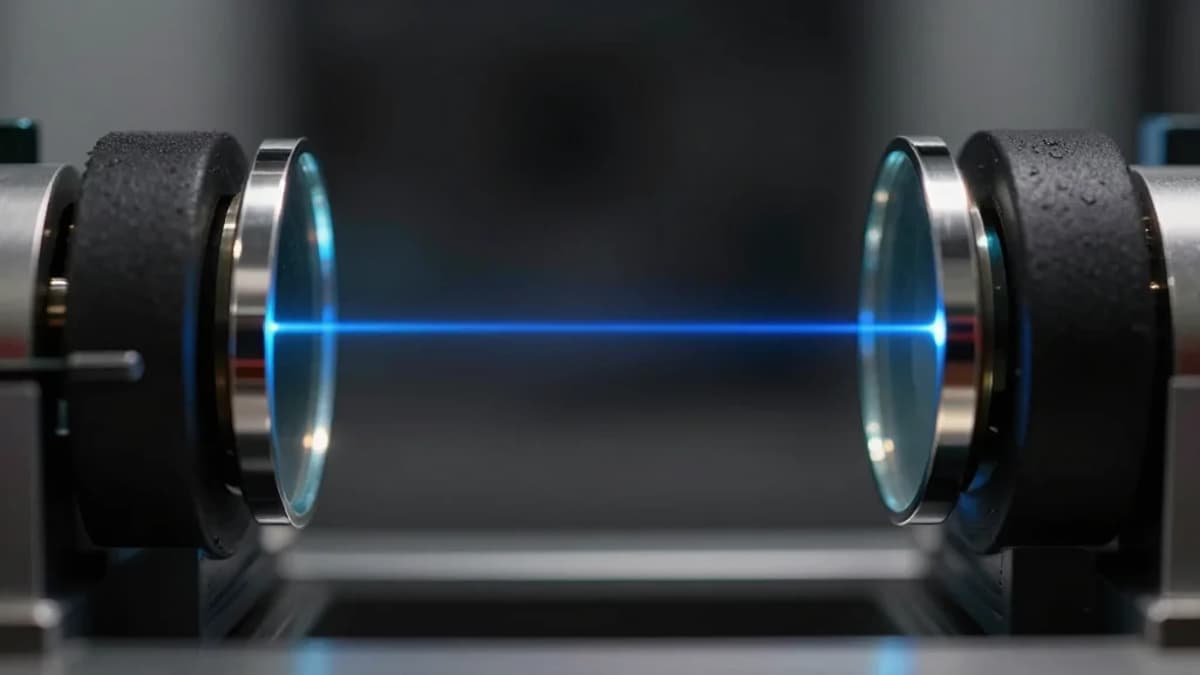
A New Method to Search for Ultralight Dark Matter with Advanced Optical Cavities
•January 29, 2026
0
Why It Matters
The technique offers a scalable, tabletop pathway to probe dark‑matter masses inaccessible to astrophysical or collider searches, potentially reshaping the experimental landscape for particle‑physics beyond the Standard Model.
Key Takeaways
- •Northwestern team uses dual Fabry‑Perot cavities for dark matter search
- •Frequency band 34‑64 kHz targets ultralight particle oscillations
- •Method yields limits five orders stronger than prior experiments
- •Cryogenic cooling combined with vibration isolation improves sensitivity dramatically
- •Future upgrades aim to span 1 kHz‑1 MHz and cut laser noise
Pulse Analysis
The new approach leverages the extraordinary length‑stability of Fabry‑Perot resonators, devices already central to gravitational‑wave observatories, to sense the infinitesimal strain a passing ultralight dark‑matter wave would impose on ordinary matter. By pairing two rigid cavities with distinct mechanical resonances, researchers isolate a frequency window where one cavity remains inertial while the other follows the dark‑matter‑induced oscillation, turning a subtle mass‑variation signal into a measurable differential length change. This clever exploitation of pendulum dynamics sidesteps many of the thermal and seismic noise challenges that have limited prior tabletop searches.
Beyond its immediate physics payoff, the experiment showcases a practical integration of cryogenic cooling and vibration isolation—two traditionally competing design goals. Achieving a low‑temperature environment while maintaining sub‑nanometer stability required custom suspension systems and high‑finesse mirrors, resulting in a sensitivity boost that translates into five orders of magnitude tighter coupling limits. These engineering advances are directly transferable to other precision‑measurement fields, including quantum sensing, frequency metrology, and next‑generation telecommunications where laser‑noise suppression is paramount.
Looking ahead, the collaboration aims to expand the searchable mass range by adding cavities of varied lengths and incorporating additional laser‑filtering stages. Extending coverage from 1 kHz up to 1 MHz would probe dark‑matter candidates spanning several orders of magnitude in mass, filling a critical gap between astrophysical observations and high‑energy collider constraints. If successful, this scalable platform could become a cornerstone of the global dark‑matter program, offering a cost‑effective complement to large‑scale detectors while driving innovation in ultra‑stable optical instrumentation.
A new method to search for ultralight dark matter with advanced optical cavities
0
Comments
Want to join the conversation?
Loading comments...