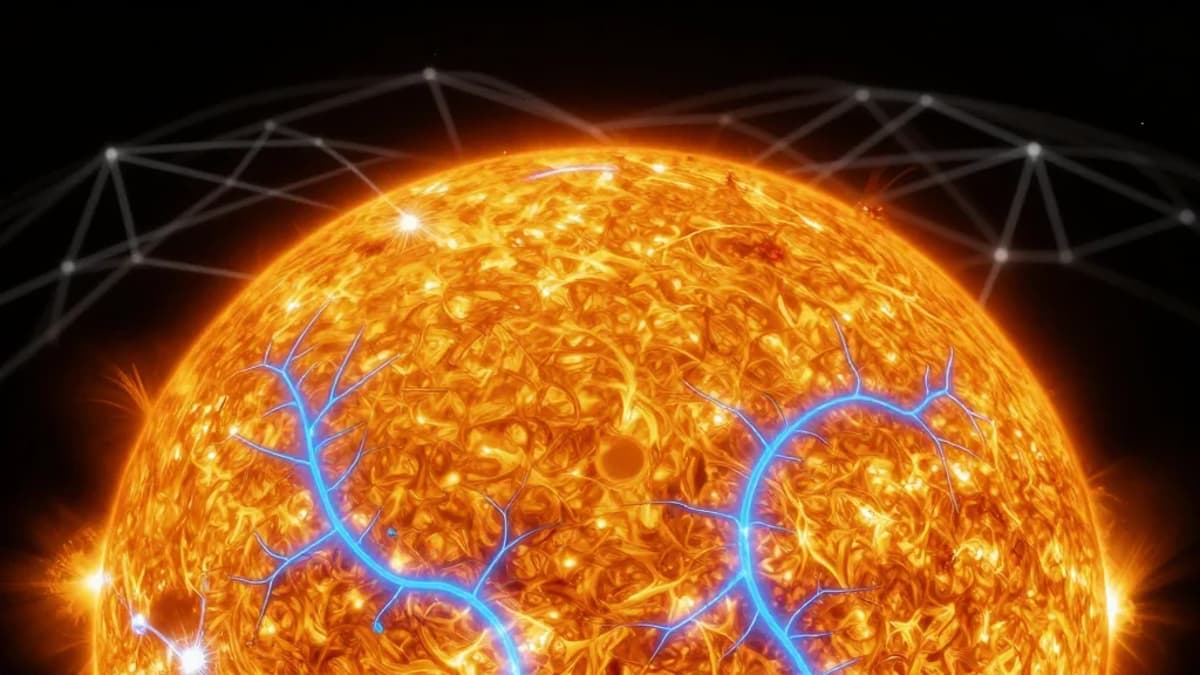
AI Tool Observes Solar Active Regions to Advance Warnings of Space Weather
•February 19, 2026
0
Why It Matters
Extending space‑weather lead time from hours to weeks gives critical infrastructure and space missions actionable preparation windows, reducing economic and safety risks. The breakthrough also demonstrates the power of physics‑informed AI in heliophysics forecasting.
Key Takeaways
- •PINNBARDS predicts active regions weeks before eruption
- •Bridges surface magnetograms to tachocline magnetic dynamics
- •Current tools only provide hours‑ahead warnings
- •Improves protection for GPS, power grids, satellites
- •Uses physics‑informed neural network on SDO/HMI data
Pulse Analysis
Space weather, driven by solar flares and coronal mass ejections, poses a persistent threat to modern technology, from navigation satellites to terrestrial power grids. Traditional forecasting relies on small‑scale magnetic signatures that only become apparent hours before an event, leaving operators with limited time to mitigate impacts. The demand for longer lead times has intensified as societies become more dependent on space‑based services, prompting researchers to explore deeper solar dynamics for earlier indicators.
The newly introduced PINNBARDS framework tackles this challenge by embedding physical constraints of magnetohydrodynamics into a neural network architecture. Leveraging high‑resolution magnetograms from NASA’s Solar Dynamics Observatory, the system inverses surface observations to reconstruct magnetic vectors and flow fields within the Sun’s tachocline—a critical transition layer that seeds active region formation. This physics‑informed approach outperforms purely data‑driven models, delivering forecasts that extend weeks ahead while maintaining scientific plausibility. By providing initial conditions for forward simulations, PINNBARDS bridges the gap between observation and predictive modeling in heliophysics.
If integrated into operational space‑weather centers, the tool could transform risk management for airlines, satellite operators, and power utilities, allowing pre‑emptive reconfiguration of vulnerable systems. Moreover, the methodology sets a precedent for AI‑enhanced forecasting across other domains where deep, inaccessible processes drive surface phenomena. Continued validation and scaling of PINNBARDS may soon enable a new generation of resilient infrastructure capable of withstanding the Sun’s most extreme outbursts.
AI tool observes solar active regions to advance warnings of space weather
0
Comments
Want to join the conversation?
Loading comments...