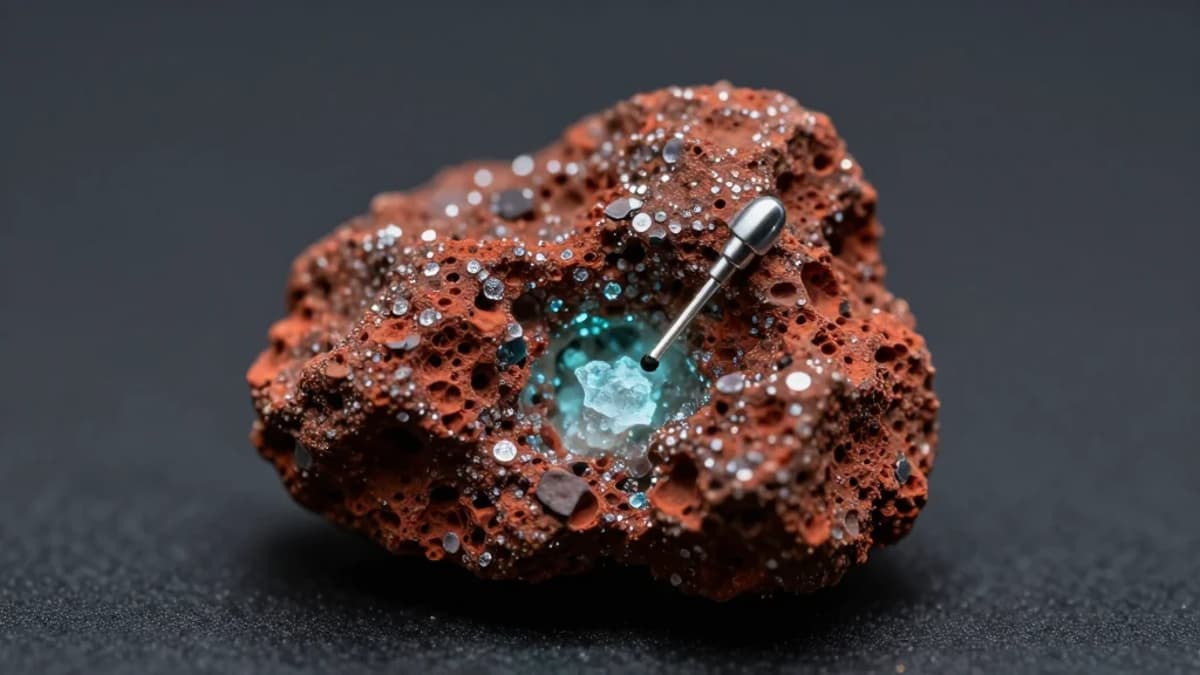
Amino Acids in Bennu Asteroid Hint at Icy Radioactive Origin
•February 10, 2026
0
Companies Mentioned

NASA
Why It Matters
The discovery broadens our understanding of how life's building blocks could arise in diverse space environments, reshaping models of organic delivery to early Earth. It highlights the need to reconsider asteroidal contributions to prebiotic chemistry.
Key Takeaways
- •Bennu glycine formed in icy, radioactive environment
- •Isotopic signatures differ from Murchison meteorite
- •Enantiomeric glutamic acid shows distinct nitrogen isotopes
- •Multiple formation pathways exist for asteroid organics
- •Findings expand prebiotic chemistry models for early solar system
Pulse Analysis
The identification of glycine in Bennu’s regolith challenges the long‑standing view that asteroid organics require liquid water for synthesis. By leveraging high‑precision isotope ratio mass spectrometry, the Penn State team detected carbon‑13 and nitrogen‑15 anomalies that align with formation in cold, ice‑rich regions bathed in cosmic radiation. This icy, radioactive pathway mirrors laboratory simulations where energetic particles drive amino acid creation within frozen mixtures, suggesting that early solar system bodies could seed planets with prebiotic compounds even far from the Sun.
Comparisons with the Murchison meteorite underscore the chemical diversity among small bodies. While Murchison’s isotopic profile supports a warm, aqueous origin, Bennu’s distinct signatures point to a separate reservoir of material that formed under markedly different conditions. Such heterogeneity implies that the nascent solar system hosted a mosaic of environments capable of producing life's precursors, complicating the narrative of a single dominant synthesis route. The divergent isotopic patterns also provide a powerful tool for tracing the provenance of extraterrestrial organics back to specific regions of the protoplanetary disk.
The broader implications extend to planetary habitability and the search for life beyond Earth. If amino acids can arise in icy, irradiated settings, then icy moons, comets, and distant asteroids may also harbor complex organics, expanding the inventory of potentially habitable worlds. Future missions that return samples from varied small bodies will test whether Bennu’s chemistry is unique or part of a wider spectrum. Understanding these formation pathways refines models of organic delivery to early Earth and informs strategies for detecting biosignatures elsewhere in the cosmos.
Amino acids in Bennu asteroid hint at icy radioactive origin
0
Comments
Want to join the conversation?
Loading comments...