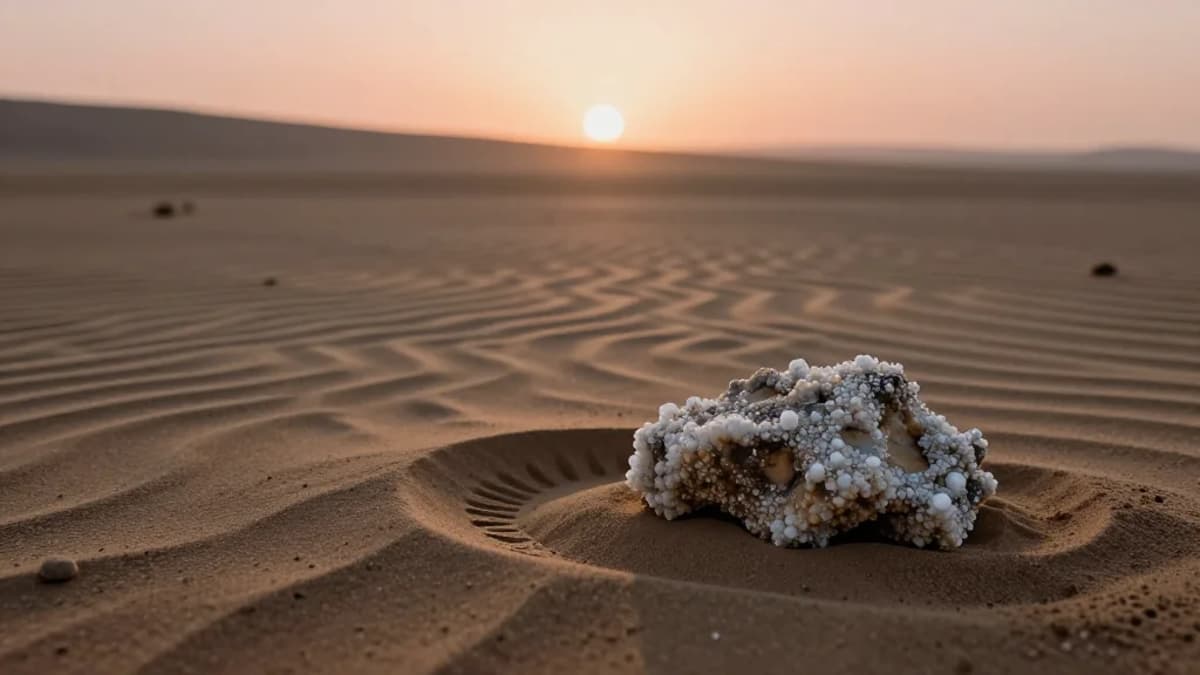
Ancient Martian Beach Discovered, Providing New Clues to Red Planet's Habitability
•January 27, 2026
0
Why It Matters
A shoreline and sustained water‑rock interaction extend the window for potential life on early Mars, making Jezero crater a prime target for biosignature detection and refining climate‑evolution models. The results also guide sample‑return priorities and future landing site selection.
Key Takeaways
- •Beach sediments prove ancient shoreline in Jezero crater
- •Carbonate alteration indicates long‑lasting subsurface water activity
- •Findings extend Mars habitability window by hundreds of millions years
- •Samples slated for Mars Sample Return will test biosignature potential
Pulse Analysis
Since the first detection of ancient river valleys, Mars has been portrayed as a once‑wet world, but concrete evidence of standing bodies of water remains scarce. The recent identification of a wave‑shaped beach within Jezero crater provides the clearest proof yet that a sizable lake possessed a true shoreline, a setting that on Earth hosts rich microbial ecosystems. By linking high‑resolution imagery from the Perseverance rover with sedimentological criteria, researchers have turned a long‑standing debate into a tangible geological feature, sharpening our picture of early Martian environments.
The Margin unit’s carbonate‑rich rocks reveal that after an initial igneous phase, circulating CO₂‑laden groundwater altered olivine into iron‑magnesium carbonates, a process analogous to terrestrial hydrothermal systems that nurture chemolithoautotrophic microbes. Such subsurface alteration implies persistent liquid water well beyond surface lake episodes, extending the habitability window by hundreds of millions of years. On Earth, similar carbonate deposits preserve organic residues for billions of years, suggesting that Jezero’s beach sediments could lock in biosignatures awaiting detection. This geological duality—igneous foundations overprinted by aqueous chemistry—offers a rare laboratory for testing Mars’ early climate models.
The upcoming Mars Sample Return mission will retrieve the very Margin and Bright Angel cores examined by Perseverance, allowing laboratory isotopic dating and high‑precision mineralogy that can confirm the timing of shoreline formation. Positive identification of organic molecules within the carbonate matrix would constitute the strongest argument yet for past life on the Red Planet. Moreover, the beach discovery reshapes target selection for future landers, emphasizing sites where sedimentary and hydrothermal signatures intersect. As the scientific community integrates these findings, models of Martian atmospheric loss and climate evolution will be recalibrated to accommodate a longer, more clement early epoch.
Ancient Martian beach discovered, providing new clues to red planet's habitability
0
Comments
Want to join the conversation?
Loading comments...