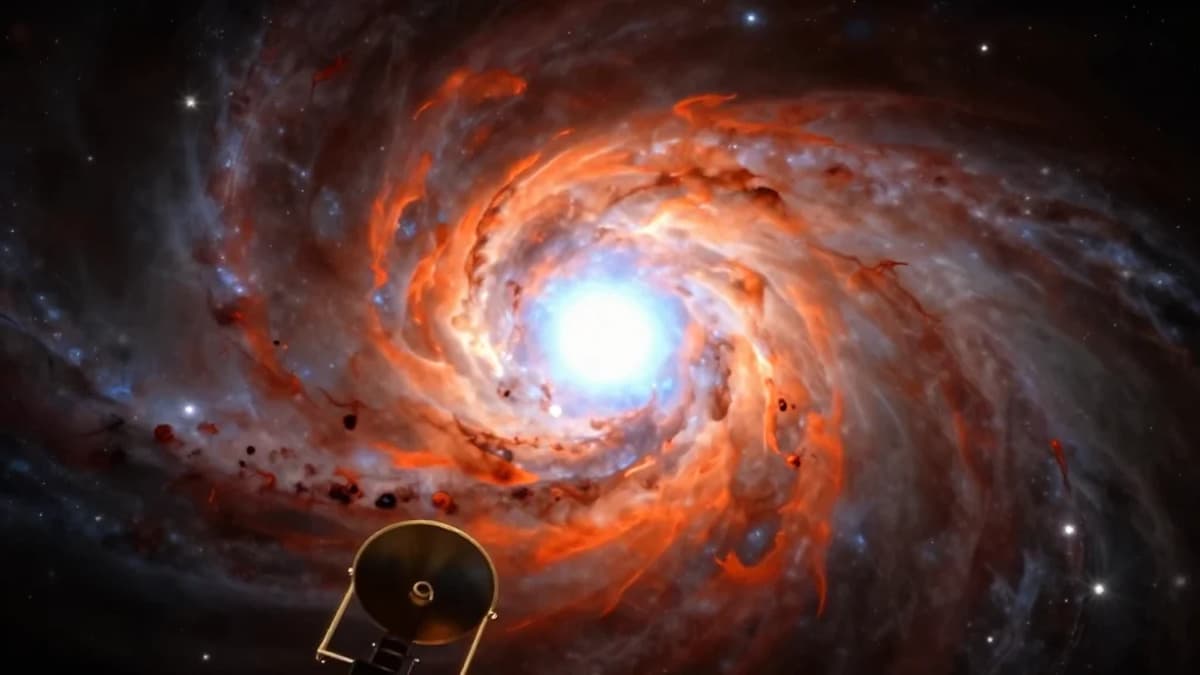
Ancient Type II Supernova Discovered From Universe's First Billion Years
•January 15, 2026
0
Why It Matters
The find provides direct evidence of massive star deaths in the early, metal‑poor universe, informing models of early stellar evolution and cosmic chemical enrichment. It also demonstrates JWST’s unique ability to probe the first billion years of cosmic history.
Key Takeaways
- •SN Eos at redshift 5.133, earliest confirmed supernova.
- •Strong gravitational lensing enabled detection of faint early‑universe event.
- •Metallicity below 10% solar, informs first‑generation star models.
- •Type IIP plateau phase observed in far‑UV at 1 Gyr age.
- •JWST demonstrates capability to probe stellar deaths after reionization.
Pulse Analysis
The detection of SN Eos pushes the frontier of observational cosmology by confirming a core‑collapse supernova at a redshift of 5.13, when the universe was roughly one billion years old. Such an event occurred shortly after the epoch of reionization, a period when the first galaxies cleared the intergalactic medium of neutral hydrogen. By capturing the ultraviolet light from a massive star that ended its life in a Type IIP explosion, astronomers gain a rare glimpse of stellar death at a time when the cosmic chemical inventory was still primitive.
The supernova was identified through a strong gravitational‑lensing configuration in the MACS 1931.8‑2635 galaxy cluster, which produced multiple magnified images of the transient. This natural telescope amplified the faint Lyman‑α‑emitting host galaxy, allowing spectroscopic confirmation of the event despite its extreme distance. SN Eos exhibits a metal abundance below ten percent of the solar value, confirming that massive stars were already forming and exploding in metal‑poor environments. Its light curve displays the characteristic plateau of a Type IIP supernova, offering direct constraints on the mass‑loss and core‑collapse physics of early massive stars.
The discovery underscores JWST’s core mission to chart the life cycles of the first generations of stars and to trace the origin of heavy elements. By extending supernova observations into the first billion years, the telescope opens a new window on how early explosions seeded galaxies with metals and influenced subsequent star formation. Future deep‑field surveys and lensing programs are expected to uncover additional high‑redshift transients, refining models of cosmic chemical enrichment and the timeline of galaxy assembly. SN Eos therefore serves as a benchmark for both theoretical and observational studies of the early universe.
Ancient Type II supernova discovered from universe's first billion years
0
Comments
Want to join the conversation?
Loading comments...