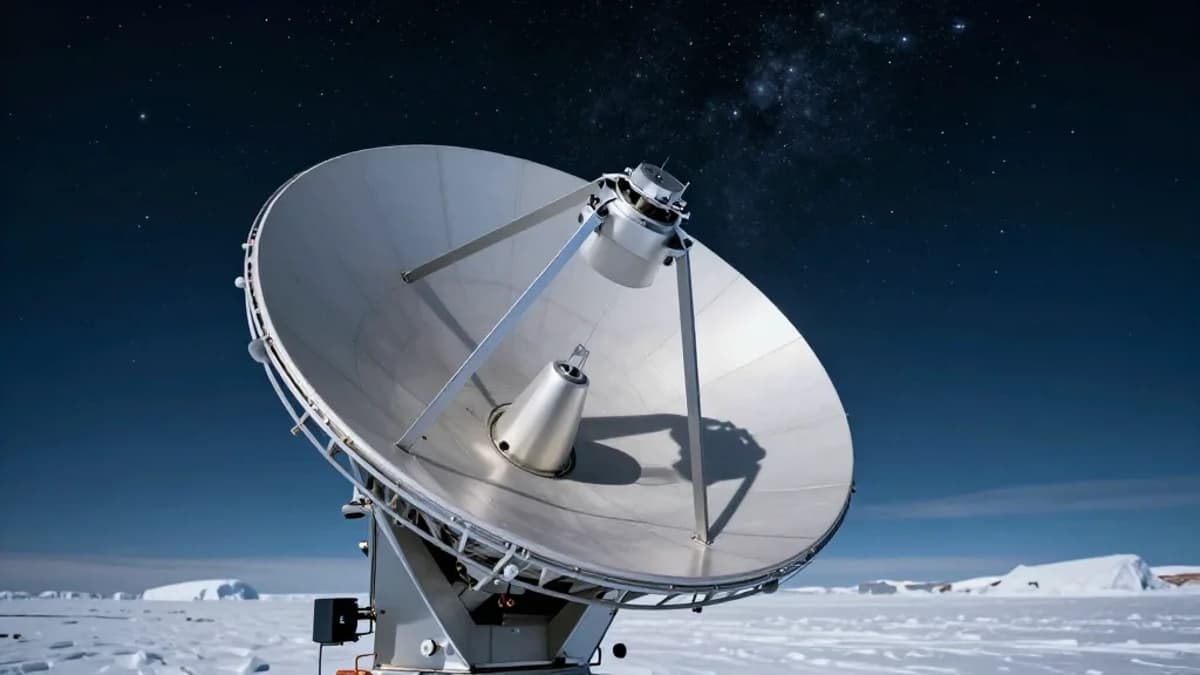
Antarctic Submillimeter Telescope Enables More Complete View of the Carbon Cycle in Star-Forming Regions
•January 15, 2026
0
Why It Matters
By delivering full carbon‑cycle measurements, the work refines models of how massive stars sculpt interstellar chemistry, a key factor in galaxy evolution and planet‑forming environments.
Key Takeaways
- •ATE60 achieved full carbon-phase mapping at Dome A.
- •Elevated C⁰/CO ratios linked to intense UV fields.
- •Antarctic plateau offers unrivaled submillimeter transparency.
- •Findings inform photodissociation region models for massive clouds.
- •Study paves way for larger Antarctic terahertz telescopes.
Pulse Analysis
Submillimeter astronomy has long been hampered by atmospheric water vapor, which absorbs terahertz radiation and obscures critical carbon‑transition lines. Dome A, perched atop the Antarctic plateau at 4,093 meters, provides an exceptionally dry, stable air column, allowing instruments like ATE60 to detect faint emissions that are invisible elsewhere. The successful deployment of a 60‑centimeter aperture with a superconducting SIS receiver proves that even modest telescopes can exploit this natural advantage, opening a new window on the interstellar medium’s chemistry.
The comprehensive carbon‑phase map produced by the Chinese team uncovers a striking elevation of atomic carbon relative to carbon monoxide in the dense interiors of RCW 79 and RCW 120. While high cosmic‑ray ionization was considered, the data align more closely with photodissociation region (PDR) models that require intense ultraviolet radiation to break CO bonds, especially in clumpy cloud structures that let UV photons penetrate deeply. This insight reshapes our understanding of how massive stars regulate molecular cloud evolution, influencing star‑formation efficiency and the initial conditions for planet formation.
Looking ahead, the Dome A experiment sets a precedent for scaling up Antarctic terahertz facilities. Larger apertures, combined with advanced detector arrays, could deliver high‑resolution surveys of carbon and other key molecules across the Milky Way and nearby galaxies. Such capabilities would not only refine galactic chemical evolution models but also support interdisciplinary research linking astrophysics, astrochemistry, and the origins of life. The Antarctic plateau is poised to become a cornerstone of next‑generation submillimeter astronomy, complementing space‑based observatories and filling critical observational gaps.
Antarctic submillimeter telescope enables more complete view of the carbon cycle in star-forming regions
0
Comments
Want to join the conversation?
Loading comments...