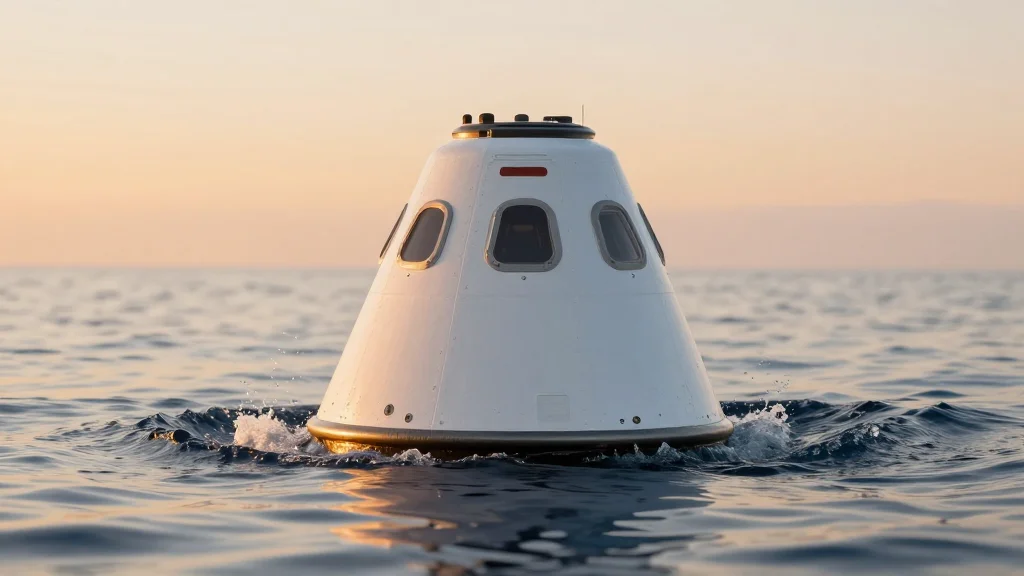
Artemis II Returns Safely to Pacific After 10‑Day Lunar Flyby

Companies Mentioned

Why It Matters
Artemis II’s successful return demonstrates that the United States has restored its capability to send humans beyond low‑Earth orbit, a capability that has been dormant since the Apollo era. This achievement re‑energizes the commercial space market, encouraging private firms to invest in lunar‑related technologies ranging from habitat modules to in‑situ resource utilization. Moreover, the mission’s data on radiation and microgravity will inform health protocols for future crewed missions to Mars, making Artemis II a foundational step in humanity’s broader deep‑space ambitions. Politically, the splashdown offers a narrative of scientific progress that can be leveraged by policymakers to garner public support and funding for the next phases of the Artemis program. In a period marked by geopolitical instability, the mission provides a unifying story of international cooperation and technological leadership, potentially shaping diplomatic discourse around space as a domain of peaceful collaboration rather than competition.
Key Takeaways
- •Artemis II splashdown in the Pacific Ocean after a 10‑day lunar flyby
- •Mission launched April 1, 2026 from Kennedy Space Center’s Pad 39B
- •Four astronauts completed a series of scientific experiments and health monitoring
- •NASA confirmed all Orion and SLS subsystems performed within design parameters
- •Success clears the path for Artemis III’s planned Moon landing later in 2026
Pulse Analysis
The Artemis II splashdown is more than a procedural checkpoint; it is a market catalyst. By proving the Orion capsule’s re‑entry and recovery systems, NASA reduces the technical risk premium that has been inflating commercial launch insurance rates for deep‑space missions. Insurers and investors will now price lunar‑orbit contracts with greater confidence, likely lowering capital costs for private firms seeking to partner on Artemis III and the lunar gateway.
Historically, each successful crewed milestone has spurred a wave of ancillary innovation. The Apollo program birthed advances in materials science, computing, and telecommunications that filtered into the civilian sector. Artemis II’s data on radiation exposure and autonomous navigation will similarly seed new product lines—radiation‑shielding fabrics for aerospace and autonomous guidance algorithms for satellite constellations. Companies that can translate these findings into commercial offerings stand to capture early‑stage market share.
Strategically, the mission reasserts U.S. leadership in a space arena that is increasingly multipolar. While China’s Chang’e program and Russia’s lunar ambitions continue, the United States now possesses a validated crewed deep‑space platform. This advantage will shape future international collaborations, with ESA and JAXA likely to deepen their involvement in the lunar gateway, while private entities such as SpaceX may secure contracts for cargo delivery to the Moon. The competitive pressure will drive down launch costs and accelerate technology maturation across the SpaceTech ecosystem.
Finally, the political dimension cannot be ignored. The timing of Artemis II’s success, amid a fragile cease‑fire in the Middle East, provides a diplomatic lever for the U.S. administration to showcase soft power. By framing space exploration as a shared human endeavor, policymakers can extract goodwill and potentially open new avenues for bilateral cooperation on scientific research, even with traditional rivals. In sum, Artemis II’s textbook touchdown is a fulcrum that will tilt both market dynamics and geopolitical narratives toward a more vibrant, collaborative, and commercially vibrant SpaceTech future.
Artemis II Returns Safely to Pacific After 10‑Day Lunar Flyby
Comments
Want to join the conversation?
Loading comments...