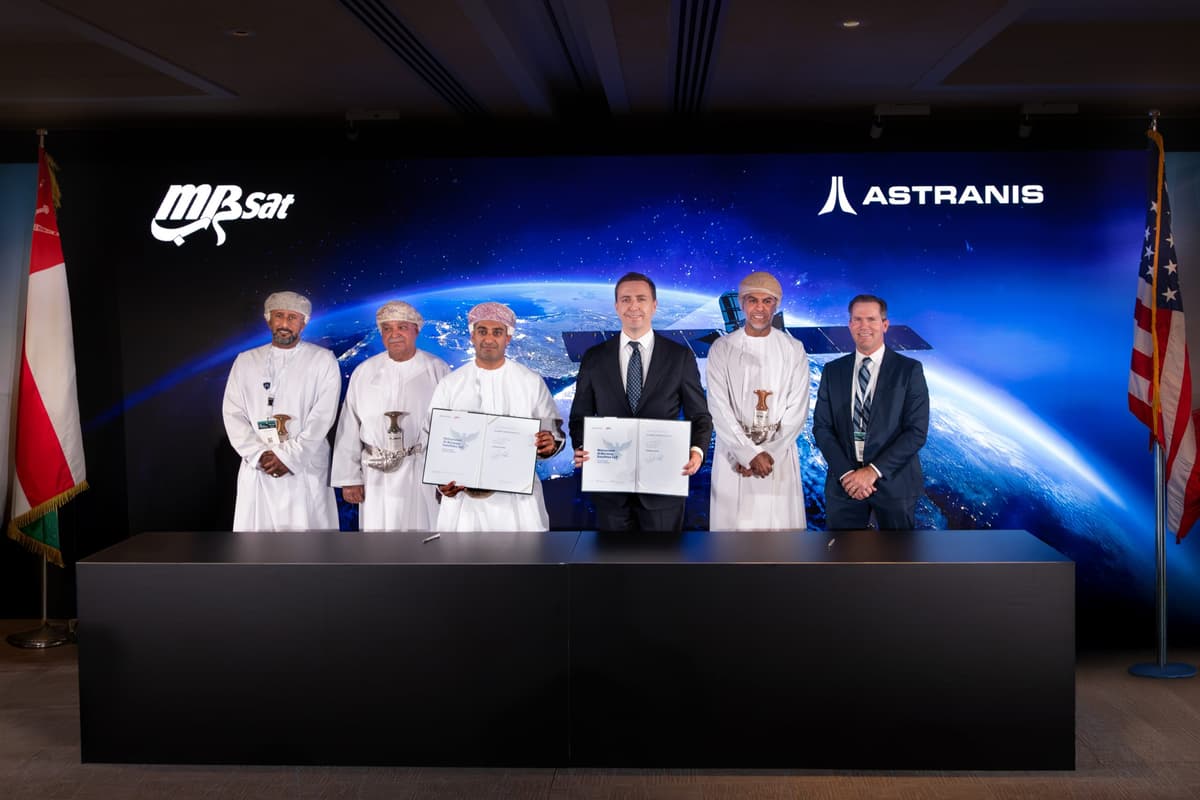
Astranis Adds Oman Customer to Summer GEO Launch Lineup
•January 26, 2026
0
Companies Mentioned


Why It Matters
The contract gives Oman sovereign control over high‑capacity digital infrastructure, accelerating Vision 2040’s digital‑first goals while expanding Astranis’s $1 billion‑plus commercial backlog.
Key Takeaways
- •Astranis secures nine‑figure deal with Oman’s MB Group
- •Satellite part of Block 3 launch on SpaceX Falcon 9
- •Contract includes ground stations and connectivity infrastructure
- •Enhances Oman’s digital diversification under Vision 2040
- •Adds to Astranis backlog exceeding $1 billion
Pulse Analysis
Astranis’s strategy of building compact, dishwasher‑sized GEO satellites is reshaping the broadband market, especially in regions where traditional fiber rollout is costly. By offering end‑to‑end solutions that bundle the spacecraft with ground‑segment hardware, the company positions itself as a one‑stop provider for governments seeking rapid, sovereign connectivity. MB Group’s investment aligns with Oman’s Vision 2040, which prioritizes digital infrastructure as a pillar of economic diversification, reducing reliance on hydrocarbons and fostering new tech‑driven industries.
The upcoming Block 3 manifest illustrates Astranis’s operational flexibility. Launching on a dedicated SpaceX Falcon 9, the satellite will share the ride with payloads for Apco Networks, Thaicom and Chunghwa Telecom, demonstrating the company’s ability to batch diverse customers while meeting individual timing needs. Unlike larger platforms such as Airbus’s OneSat, Astranis’s design supports multiple frequency bands—including Ku, Q, V and Ka—enabling versatile service offerings from remote villages to maritime routes. This technical edge, coupled with a $200 million contract covering ground infrastructure, underscores the commercial viability of small GEO assets in emerging markets.
The broader industry is witnessing a surge in sovereign satellite initiatives, as nations like Oman seek control over critical communications. Small GEO constellations provide a cost‑effective bridge between traditional large‑scale satellites and low‑Earth‑orbit constellations, delivering regional coverage with lower latency than geostationary behemoths. Astranis’s growing backlog, now exceeding $1 billion, signals strong demand for this niche. Coupled with Oman’s plans for a domestic spaceport and collaborations with European and Chinese partners, the region is poised to become a hotbed for next‑generation satellite services, driving competition and innovation across the global connectivity landscape.
Astranis adds Oman customer to summer GEO launch lineup
0
Comments
Want to join the conversation?
Loading comments...