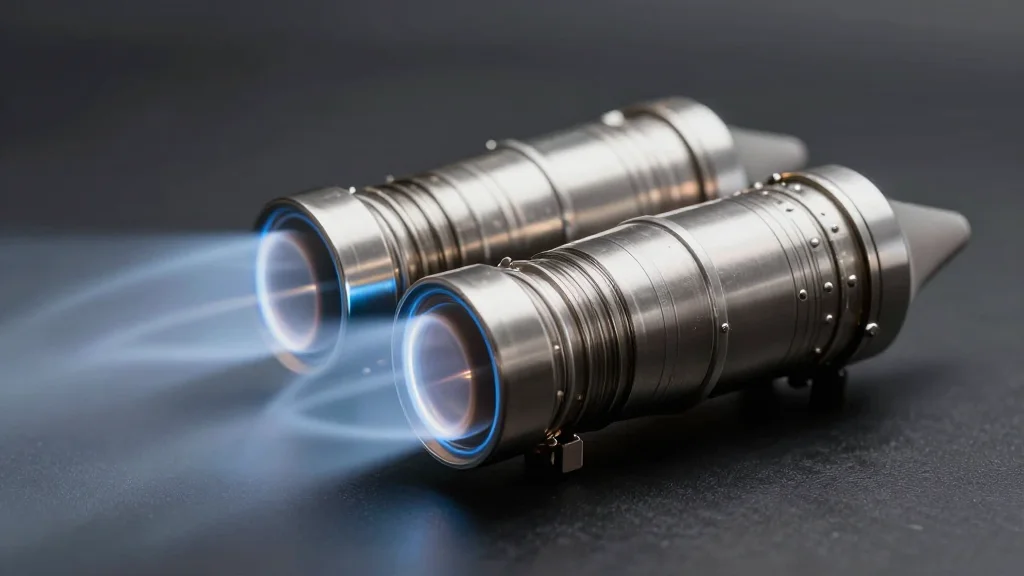
Astrobotic Sets Record with 470‑Second Rotating‑Detonation Engine Test

Companies Mentioned
Why It Matters
The successful 470‑second RDRE test demonstrates that detonation‑based propulsion is moving from theory to operational readiness, offering a pathway to more efficient lunar and deep‑space missions. By delivering higher thrust per unit of propellant, RDREs could lower launch costs and increase payload capacity, directly impacting the economics of commercial lunar exploration and cislunar logistics. If Astrobotic can translate ground‑test performance into flight‑qualified engines, the technology could challenge conventional chemical rockets for specific mission segments, prompting larger players like SpaceX and Blue Origin to evaluate detonation concepts for future vehicle architectures. The test also signals to investors that the RDRE market is maturing, potentially unlocking new funding streams for companies pursuing high‑energy propulsion.
Key Takeaways
- •Astrobotic fired twin Chakram RDREs for a total of 470 seconds, including a 300‑second continuous burn.
- •Each engine generated over 4,000 pounds of thrust during the test at NASA’s Marshall Space Flight Center.
- •The test sets the longest duration record for any rotating‑detonation rocket engine design.
- •Astrobotic plans to integrate the engines into its Griffin lunar lander, slated for a Falcon Heavy launch no earlier than July.
- •Other RDRE efforts include Venus Aerospace’s 2025 flight test and JAXA’s 2021 space‑based firing.
Pulse Analysis
Astrobotic’s record‑breaking RDRE test arrives at a pivotal moment for propulsion innovation. Historically, rocket development has been dominated by steady‑combustion cycles, but detonation‑driven engines promise a step‑change in specific impulse—a metric that directly translates to lower propellant mass and higher payload fractions. The 300‑second continuous burn demonstrates that the Chakram design can sustain detonation stability far beyond the brief pulses typical of earlier prototypes, addressing a key reliability hurdle.
From a market perspective, the test could catalyze a shift in how commercial lunar services are priced. Current lunar lander contracts often hinge on the mass‑to‑orbit capability of existing launch vehicles. If Astrobotic can prove that RDREs reduce the mass of onboard propellant, the Griffin lander could offer more cargo or scientific payloads for the same launch cost, making it more attractive to NASA’s Artemis partners and private customers alike. This competitive edge may also force incumbents to accelerate their own high‑energy propulsion research, potentially leading to a wave of hybrid engine concepts that blend conventional and detonation cycles.
Looking forward, the next critical milestone is an in‑flight demonstration that validates RDRE performance in microgravity and under launch‑load conditions. Success there would not only solidify Astrobotic’s position as a propulsion pioneer but also open doors to broader applications such as in‑space transfer vehicles and rapid‑transit cargo shuttles. Investors and policymakers should watch the forthcoming data releases closely, as they will likely shape funding decisions and regulatory pathways for next‑generation space propulsion.
Astrobotic Sets Record with 470‑Second Rotating‑Detonation Engine Test
Comments
Want to join the conversation?
Loading comments...