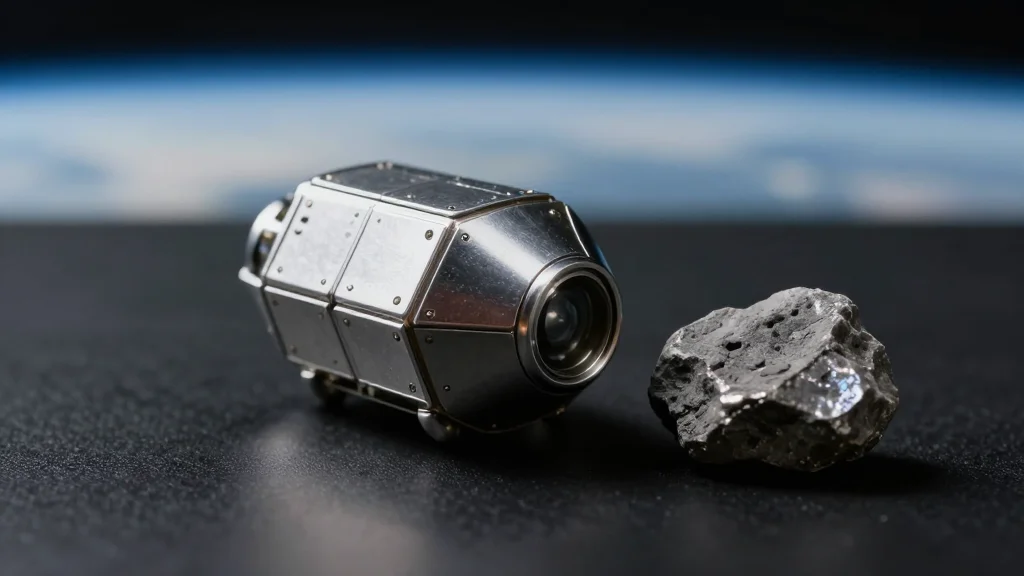
AstroForge Completes DeepSpace-2 Assembly, Targets Asteroid Flyby

Companies Mentioned
Why It Matters
DeepSpace‑2 represents the first fully built spacecraft from an asteroid‑mining startup, moving the concept from laboratory studies to a flight‑tested platform. Success would prove that low‑cost, modular spacecraft can survive interplanetary travel, lowering barriers for both commercial prospecting and scientific exploration. Moreover, the mission’s rideshare launch model demonstrates how emerging space firms can leverage existing launch infrastructure to achieve deep‑space objectives without the expense of dedicated rockets. Beyond the technical achievement, the mission could influence policy discussions on the extraction and ownership of extraterrestrial resources. As governments and international bodies grapple with the legal framework for asteroid mining, a demonstrable, privately funded mission may accelerate the development of clear guidelines, encouraging further private investment and potentially reshaping the supply chain for critical metals needed on Earth and in space.
Key Takeaways
- •AstroForge completed assembly of DeepSpace‑2 on June 4, 2026.
- •Spacecraft cost "just under" $5 million; total mission budget under $10.5 million.
- •DeepSpace‑2 will launch as a rideshare on a Falcon 9 carrying Intuitive Machines’ IM‑3 lunar lander.
- •The modular platform can carry up to 50 kg of payload and includes redundant solar‑array design.
- •Mission aims to fly by a near‑Earth asteroid within 2‑9 months of launch, delivering high‑resolution imagery.
Pulse Analysis
AstroForge’s approach flips the traditional cost model for deep‑space missions on its head. By standardizing a 50‑kg payload bus and pricing the entire vehicle at under $5 million, the company is creating a "spacecraft as a service" offering that could democratize access to asteroid prospecting. This mirrors trends in the satellite industry, where small, mass‑produced platforms have driven down launch costs and spurred a wave of commercial services. If DeepSpace‑2 validates its design, we could see a cascade of similar buses launched on rideshare slots, each incrementally improving the data set on asteroid composition and orbital dynamics.
The competitive landscape is still nascent, but AstroForge’s progress forces larger players to reckon with a new class of agile competitors. SpaceX’s mention of asteroid mining in its prospectus signals strategic interest, yet the company has yet to commit resources to a dedicated mission. AstroForge’s success could either push SpaceX to accelerate its own plans or encourage partnerships where larger launch providers supply rideshare capacity to specialized miners. Either scenario would increase launch demand and potentially lower prices for secondary payloads, benefiting the broader commercial space ecosystem.
Looking ahead, the key risk remains the technical reliability of the spacecraft in the harsh environment of interplanetary space. The Odin failure underscored how a single subsystem—solar array deployment—can jeopardize an entire mission. AstroForge’s added contingencies and rigorous pre‑flight testing are prudent, but the proof will be in the data returned from the asteroid flyby. Investors and policymakers will be watching closely; a successful mission could unlock a new revenue stream from asteroid‑derived metals, while a setback might reinforce the perception that asteroid mining remains a distant dream.
AstroForge Completes DeepSpace-2 Assembly, Targets Asteroid Flyby
Comments
Want to join the conversation?
Loading comments...