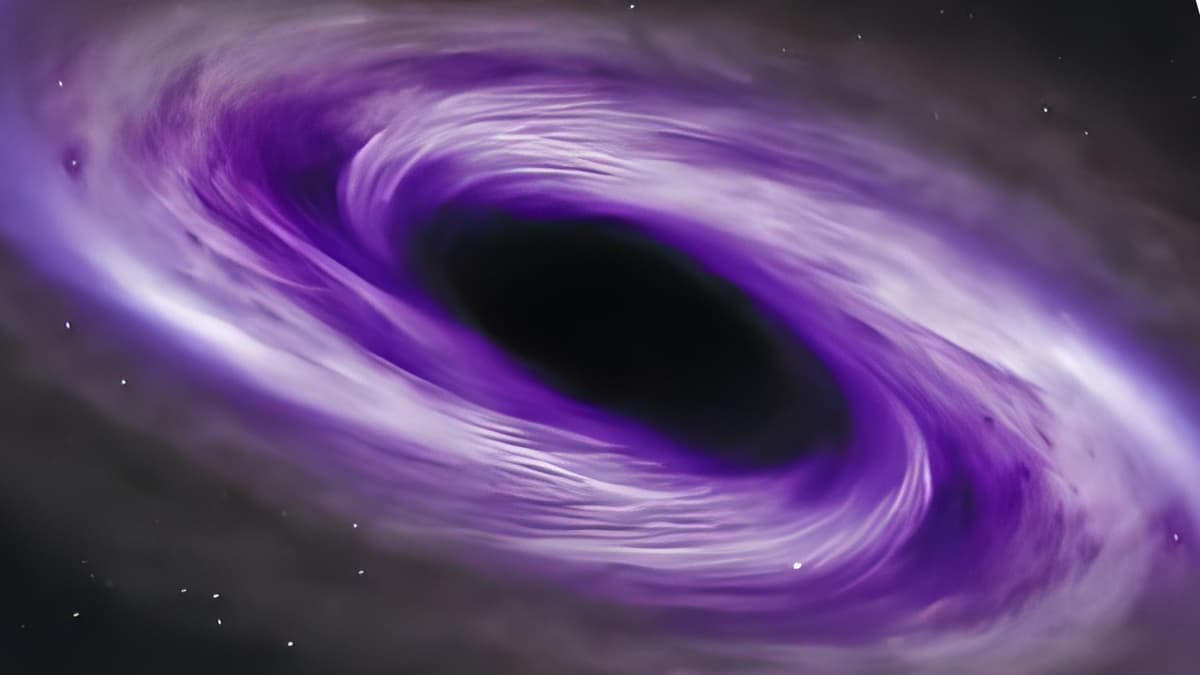
Astronomers Baffled by 'Mysterious Disruptor' With a Mass of 1 Million Suns and a Black Hole for a Heart
•January 12, 2026
0
Why It Matters
The find challenges prevailing dark‑matter theories and demonstrates that gravitational lensing can reveal unseen mass at cosmological distances, reshaping our understanding of structure formation.
Key Takeaways
- •Object mass equals one million solar masses.
- •Central black‑hole‑like core holds ~25% of mass.
- •Extends as massive, low‑density disk beyond typical galaxies.
- •Detected solely via gravitational lensing at 11 billion light‑years.
- •Existing dark‑matter models cannot reproduce its density profile.
Pulse Analysis
The discovery of the so‑called "mysterious disruptor" underscores the power of gravitational lensing as a cosmic microscope. By analyzing subtle perturbations in the light arc of JVAS B1938+666, astronomers inferred a massive, invisible object without any electromagnetic signature. This technique, rooted in Einstein’s general relativity, allows researchers to map mass distributions far beyond the reach of traditional telescopes, opening a new window onto the dark side of the universe.
What makes the disruptor especially intriguing is its hybrid structure. At its heart lies a compact region consistent with a black‑hole or dense stellar core, accounting for roughly a quarter of the total mass. Surrounding this core is an expansive, disk‑like component whose density tapers far more gently than any known galaxy or star cluster of comparable mass. Such a profile defies standard cold‑dark‑matter simulations, prompting theorists to consider exotic alternatives, including self‑interacting dark matter or primordial black‑hole clusters.
Looking ahead, the object will become a benchmark for next‑generation observatories. Instruments like the James Webb Space Telescope, the Extremely Large Telescope, and upcoming radio arrays will provide higher‑resolution lensing data and possibly detect faint emissions, if any exist. Refining models to accommodate this outlier could tighten constraints on dark‑matter particle properties and improve estimates of the universe’s mass‑energy budget. In short, the disruptor not only expands the taxonomy of cosmic structures but also serves as a critical test case for the physics governing the invisible majority of the cosmos.
Astronomers baffled by 'mysterious disruptor' with a mass of 1 million suns and a black hole for a heart
0
Comments
Want to join the conversation?
Loading comments...