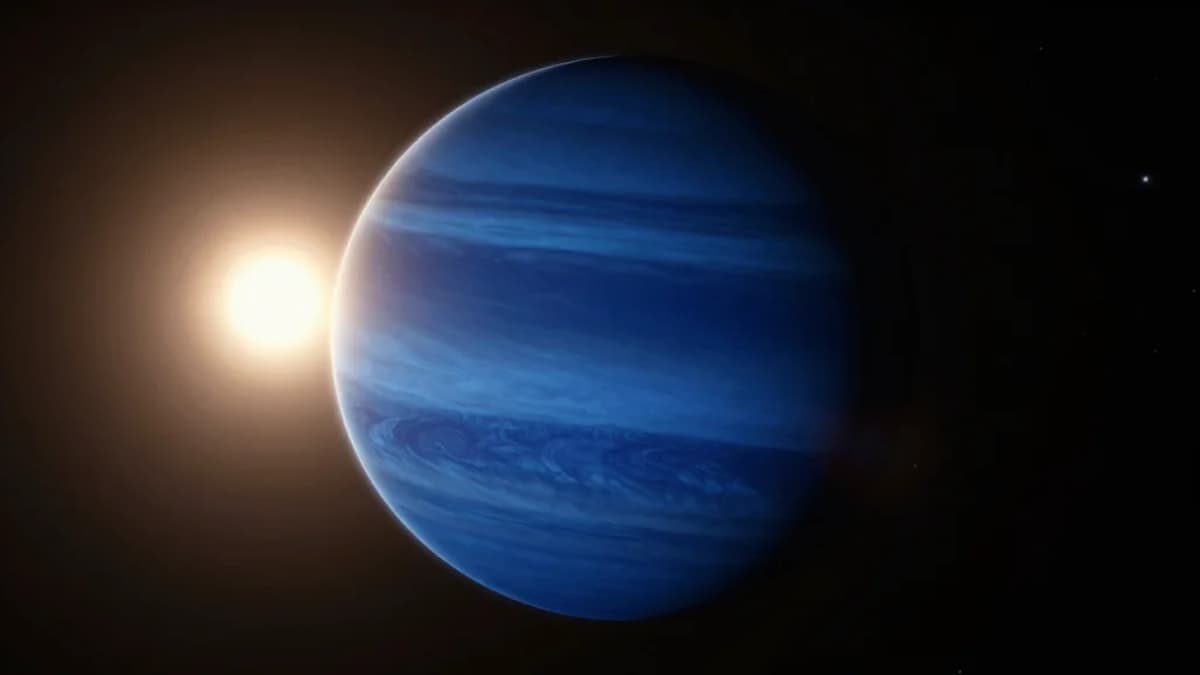
Astronomers Discover Dense Super-Neptune Exoplanet Orbiting a Sun-Like Star
•January 22, 2026
0
Why It Matters
TOI‑3862 b provides a rare benchmark for testing theories of atmospheric stripping and planetary structure in extreme irradiation environments, informing models of planet formation and evolution.
Key Takeaways
- •TOI‑3862 b dense super‑Neptune with 1.75 g cm⁻³ density
- •Orbits sun‑like star every 1.56 days at 0.025 AU
- •Located in hot‑Neptune desert, rare short‑period Neptune‑size
- •Mass 0.169 Jupiter masses, half Jupiter radius
- •Likely stripped atmosphere; iron core 38‑41%
Pulse Analysis
The discovery of TOI‑3862 b underscores the power of TESS’s all‑sky survey to uncover exotic worlds that challenge conventional planet‑formation paradigms. While TESS has catalogued over 7,800 candidates, only a fraction have been confirmed, and this dense super‑Neptune stands out because it inhabits the hot‑Neptune desert—a region where strong stellar irradiation is expected to erode volatile envelopes. By combining precise transit photometry with radial‑velocity follow‑up, researchers measured both radius and mass, revealing an unusually high density that points to a substantial rocky‑iron core and a thin residual atmosphere.
From a theoretical standpoint, TOI‑3862 b validates models that predict rapid atmospheric loss for Neptune‑size planets on ultra‑short orbits. The planet’s estimated age of 7.5 billion years suggests it has endured billions of years of intense stellar flux, shedding most of its primordial hydrogen‑helium layer. This makes it an ideal laboratory for studying the end‑state of atmospheric stripping, offering clues about how many close‑in Neptunes may evolve into super‑Earths or barren cores. Moreover, its metal‑rich composition aligns with emerging trends that link host‑star metallicity to the bulk density of close‑in planets.
Looking ahead, TOI‑3862 b will be a prime target for upcoming facilities such as the James Webb Space Telescope and the European Extremely Large Telescope. High‑resolution spectroscopy could detect trace gases in its tenuous atmosphere, while phase‑curve observations may map temperature gradients across its dayside. These follow‑up studies will refine our understanding of atmospheric retention thresholds and inform the statistical distribution of planets in the hot‑Neptune desert, shaping future exoplanet surveys and theoretical frameworks.
Astronomers discover dense super-Neptune exoplanet orbiting a sun-like star
0
Comments
Want to join the conversation?
Loading comments...