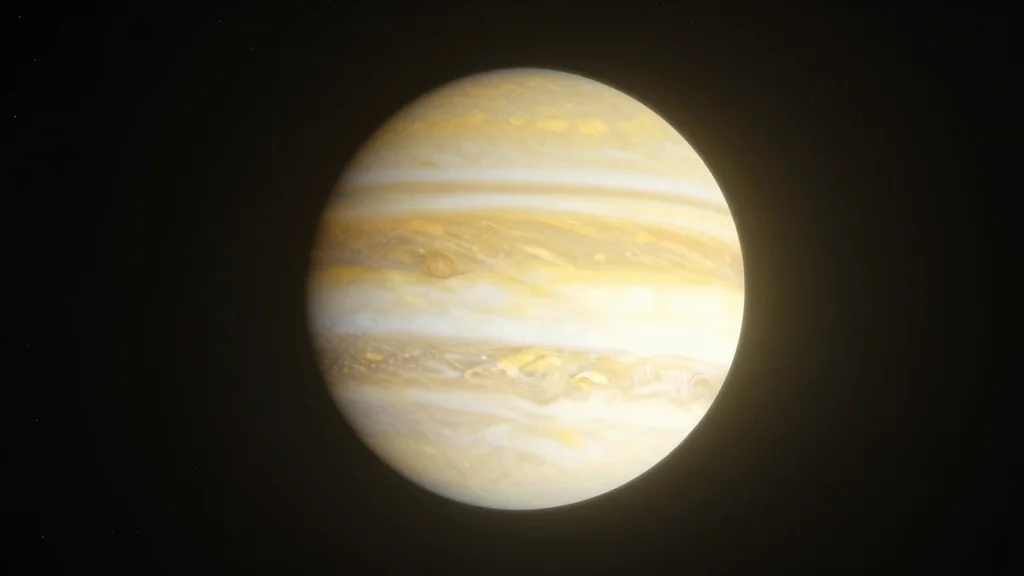
Astronomers Discover Rare Super-Jupiter Orbiting Distant Star
Why It Matters
The discovery expands the sample of warm‑Jupiters, informing models of giant‑planet formation and migration, and demonstrates TESS's ability to detect long‑period transits.
Key Takeaways
- •Radius 1.08 Jupiter, mass 4.78 Jupiter masses.
- •180.5‑day orbit at 0.7 AU from host star.
- •One of 13 TESS planets with periods over 100 days.
- •Density 4.69 g/cm³; equilibrium temperature 458 K.
- •May host inner planets, exomoon, or ring system.
Pulse Analysis
TESS’s primary strength has been spotting short‑period planets, yet the detection of TIC‑65910228 b underscores the mission’s growing sensitivity to longer orbital cycles. By capturing a single transit in sector 33 and leveraging ground‑based photometry and high‑precision radial‑velocity follow‑up, the international team turned a faint signal into a well‑characterized warm super‑Jupiter. This achievement adds a valuable data point to the modest cohort of transiting giants beyond 100‑day periods, helping astronomers refine occurrence rates for such worlds across the galaxy.
The planet’s high density and moderate equilibrium temperature set it apart from the inflated hot Jupiters that dominate exoplanet catalogs. Its composition hints at a substantial heavy‑element core, offering clues about core‑accretion efficiency in metal‑rich, F‑type stellar environments. Although its relatively cool atmosphere limits immediate transmission‑spectroscopy with existing facilities, the object serves as a benchmark for future infrared observatories that could probe nitrogen‑bearing molecules predicted to survive at these temperatures.
Beyond the planet itself, the system’s architecture invites speculation about additional bodies. Warm Jupiters often coexist with smaller inner companions, and the wide orbital separation of TIC‑65910228 b creates a stable zone for potential terrestrial planets, exomoons, or ring structures. Continued monitoring with next‑generation surveys and precise radial‑velocity instruments could reveal such companions, enriching our understanding of multi‑planet dynamics and habitability prospects around massive, distant giants.
Astronomers discover rare super-Jupiter orbiting distant star
Comments
Want to join the conversation?
Loading comments...