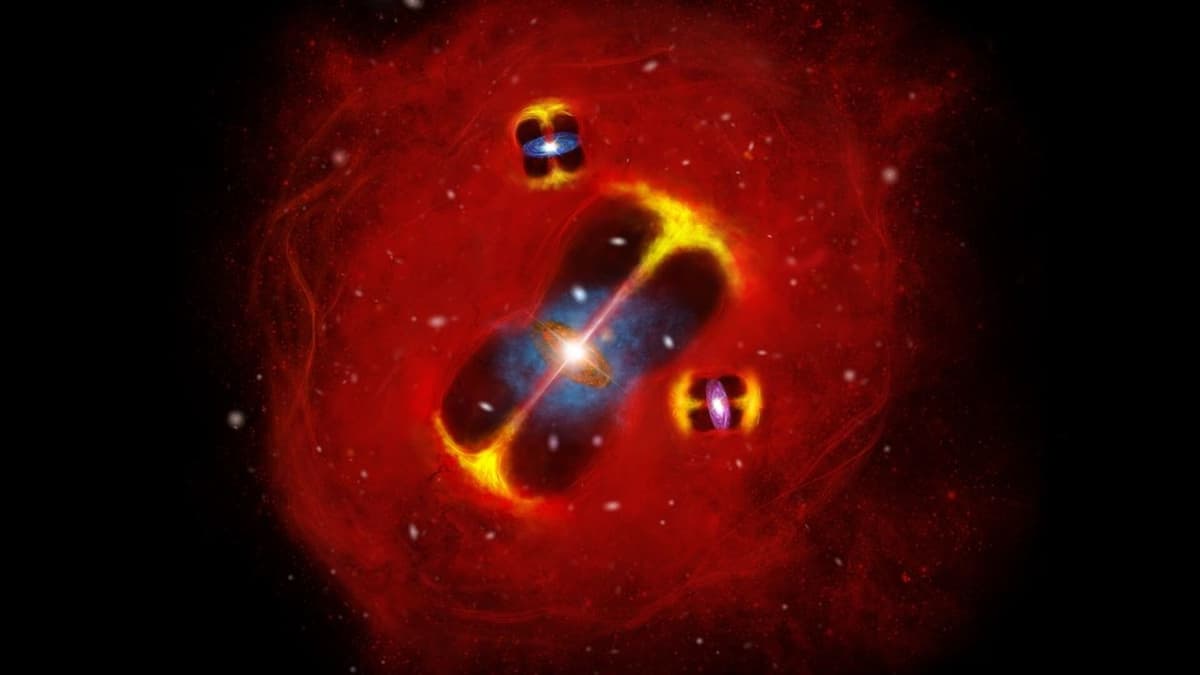
Astronomers Discover the Earliest, Hottest Galaxy Cluster in the Universe, and It Breaks All the Rules
•January 7, 2026
0
Companies Mentioned

Why It Matters
This early, overheated cluster forces a revision of cosmological simulations of structure formation and informs how present‑day massive clusters assembled, offering a unique laboratory to study starburst‑black‑hole‑gas interactions in the young universe.
Key Takeaways
- •Over 30 galaxies packed into 500,000‑light‑year region
- •Intracluster gas temperature five times hotter than predictions
- •Star formation rates 5,000× Milky Way’s average
- •Cluster already gravitationally bound, unlike earlier protoclusters
- •Discovery challenges standard models of cluster thermal evolution
Pulse Analysis
The detection of SPT2349‑56 reshapes our view of galaxy cluster formation in the first two billion years of cosmic history. While traditional simulations predict a gradual heating of the intracluster medium over several gigayears, this system exhibits temperatures comparable to mature, low‑redshift clusters. Such an anomaly suggests that the dynamical collapse of galaxies and the associated shock heating can occur far more rapidly than previously thought, prompting theorists to revisit the physics of early‑universe gas accretion and feedback mechanisms.
ALMA’s measurement of the Sunyaev‑Zeldovich effect provided a precise temperature estimate for the hot gas, bypassing the need for direct X‑ray detection, which is challenging at high redshift. Simultaneously, the constituent galaxies are undergoing star‑formation frenzies—producing thousands of solar masses of new stars each year—and host three actively accreting supermassive black holes. This confluence of intense starbursts, black‑hole activity, and an overheated atmosphere creates a natural laboratory for probing how feedback processes regulate galaxy growth and heat the surrounding medium in the early universe.
The broader implication is a call for more sophisticated cosmological models that incorporate rapid, high‑efficiency cooling‑loss suppression and early gravitational binding. Upcoming observations with JWST and next‑generation facilities like the Extremely Large Telescope will target similar compact clusters, testing whether SPT2349‑56 is an outlier or a missing class of early structures. Refining these models will improve predictions of large‑scale structure evolution and the timeline of galaxy cluster assembly across cosmic time.
Astronomers discover the earliest, hottest galaxy cluster in the universe, and it breaks all the rules
0
Comments
Want to join the conversation?
Loading comments...