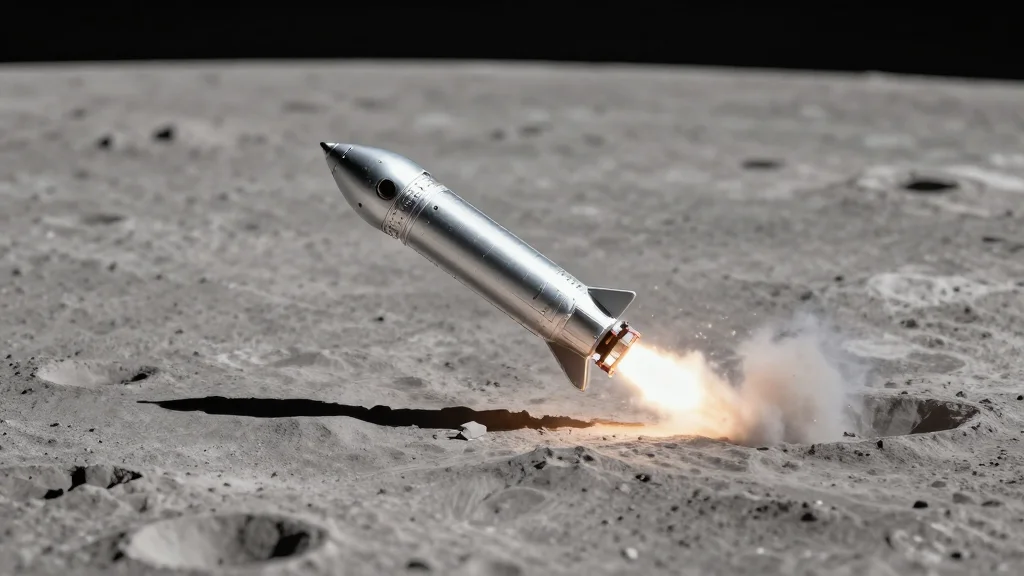
Astronomers Forecast Falcon 9 Upper Stage to Strike Moon at Mach 7 on Aug. 5

Companies Mentioned
Why It Matters
The predicted impact underscores a looming challenge for the burgeoning SpaceTech ecosystem: managing orbital debris in a region that is transitioning from a pristine scientific frontier to a hub of commercial and governmental activity. As lunar missions multiply, the probability of accidental collisions—whether with spacecraft, habitats, or future infrastructure—will rise, potentially jeopardizing multi‑billion‑dollar investments. Moreover, the event offers a rare, real‑world data point for impact physics on an airless body. By studying the fresh crater, researchers can validate models that inform everything from landing site selection to shielding design, directly influencing the safety and cost‑effectiveness of upcoming lunar habitats and resource‑extraction projects.
Key Takeaways
- •Falcon 9 upper stage (13.8 m tall) predicted to hit Moon on Aug. 5 at 2:44 a.m. EDT
- •Impact speed estimated at 5,400 mph (Mach 7), creating a new crater near Einstein crater
- •Project Pluto software logged 1,053 observations of the stage since launch
- •No immediate danger to Earth or lunar assets, but highlights debris disposal issues
- •U.S. and China plan accelerated lunar missions, increasing need for debris mitigation
Pulse Analysis
The August 5 impact is less a spectacle than a warning bell for the SpaceTech sector. Historically, lunar debris has been a peripheral concern; the Apollo era left only a handful of inert objects. Today, the cadence of launches—driven by Artemis, commercial landers, and Chinese lunar ambitions—means that each discarded stage adds measurable risk. The fact that a spent Falcon 9 stage can be tracked with such precision demonstrates the maturity of orbital‑debris surveillance, yet the very existence of the object in a quasi‑stable Earth‑Moon orbit reveals a gap in end‑of‑life planning.
From a market perspective, the incident could accelerate investment in debris‑removal services and in technologies that place spent stages on solar‑orbit trajectories. Companies like Astroscale, already testing magnetic capture nets, may find a broader customer base among lunar mission planners seeking compliance with emerging “space sustainability” guidelines. Simultaneously, insurers are likely to adjust risk models for lunar payloads, factoring in the probability of impact from legacy hardware.
Looking ahead, the scientific community will benefit from the fresh crater as a natural experiment. High‑resolution imaging from lunar orbiters can calibrate impact‑crater scaling laws, improving predictions for future lander touchdowns and even for asteroid deflection strategies. In short, the August impact is a micro‑event with macro‑implications: it spotlights the need for stricter debris policies, opens commercial opportunities for mitigation services, and provides a data set that could make lunar operations safer and more predictable.
Astronomers Forecast Falcon 9 Upper Stage to Strike Moon at Mach 7 on Aug. 5
Comments
Want to join the conversation?
Loading comments...