Astronomers Unlock a Sharper View From JWST Using a ‘Keyhole’ Trick
Why It Matters
The breakthrough restores JWST’s high‑resolution capability, expanding its scientific reach to directly observe close‑in exoplanets and fine structures in distant galaxies. This could accelerate discoveries about planetary atmospheres and black‑hole jets, reinforcing JWST’s role as a premier observatory.
Key Takeaways
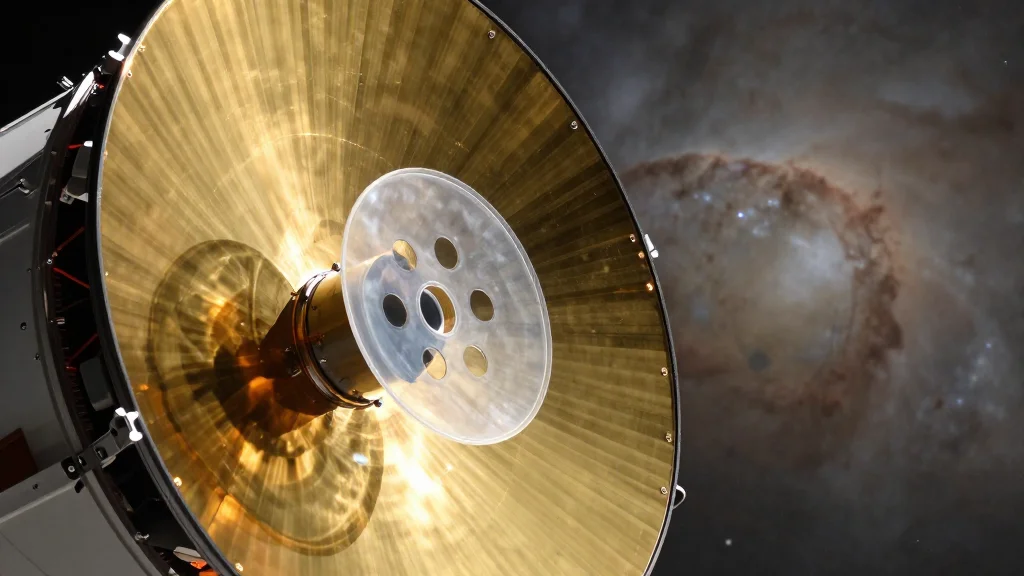
- •JWST's Aperture Masking Interferometer uses a 5‑cm mask with seven holes
- •Forward‑modeling corrected detector charge‑leak errors, restoring AMI performance
- •Demonstrations imaged Io’s volcanoes and a dusty binary star at high resolution
- •Technique promises direct imaging of close‑in exoplanets beyond coronagraph limits
- •Noise‑cancelling interferometry on a single mirror achieves cleaner pictures of compact objects
Pulse Analysis
Interferometry has long been the workhorse of radio astronomy, linking dishes across continents to synthesize apertures far larger than any single dish. Translating that concept to the optical regime is far more demanding because light’s wavelength is orders of magnitude shorter. JWST’s designers anticipated this challenge by embedding a tiny metal mask—known as the Aperture Masking Interferometer—within the NIRISS instrument. The mask’s seven holes generate multiple baselines across the primary mirror, allowing the telescope to act like a compact interferometric array and suppress noise in bright, point‑like sources.
When the AMI was first deployed, its promise fell short as infrared detectors suffered charge‑leakage, scrambling the delicate interference pattern. Rather than abandon the mode, a consortium led by Leiden Observatory and the University of Sydney constructed a comprehensive forward model that simulates every step from photon arrival to pixel readout. By iteratively adjusting a guessed sky scene until the simulated output matched the corrupted data, they effectively reverse‑engineered the true image. This digital‑twin approach not only rescued the AMI’s performance but also set a precedent for correcting complex detector systematics in space‑based instruments.
The restored capability opens a new frontier for JWST: direct imaging of planets that orbit within the inner glare of their host stars, a region where traditional coronagraphs lose sensitivity. Capturing photons from these close‑in worlds will enable spectroscopic studies of atmospheric composition, surface conditions, and potential habitability. Beyond exoplanets, the technique can resolve fine structures in active galactic nuclei, protoplanetary disks, and stellar outflows, delivering insights that complement JWST’s existing suite of instruments. As the astronomy community prepares for the next generation of space telescopes, the AMI success story underscores the value of innovative hardware paired with sophisticated software, a model likely to influence future mission designs.
Astronomers unlock a sharper view from JWST using a ‘keyhole’ trick
Comments
Want to join the conversation?
Loading comments...