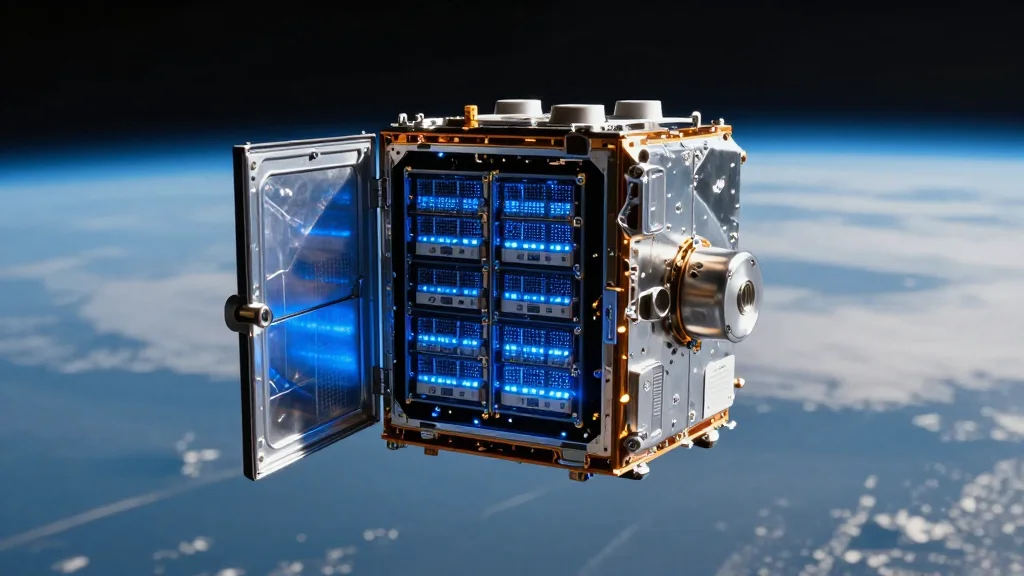
Atomic-6 Unveils ODC.space Marketplace to Offer Orbital Data Centers for AI

Why It Matters
Orbital data centers could redefine the economics of high‑performance computing by decoupling capacity from terrestrial constraints such as land availability, power grid capacity and local permitting. For AI developers, the ability to lease space‑based compute could shorten time‑to‑market for models that require massive parallel processing, especially in scenarios where data is already collected by satellites. Moreover, the marketplace model lowers the barrier to entry for organizations without existing space programmes, potentially expanding the customer base for launch services and satellite component manufacturers. If Atomic‑6’s ODC.space proves viable, it may trigger a wave of similar offerings, accelerating the emergence of a space‑based cloud computing ecosystem. This would have downstream effects on data‑security regulations, insurance underwriting for space assets, and the strategic calculus of governments seeking resilient, sovereign compute infrastructure.
Key Takeaways
- •Atomic-6 launched ODC.space, a marketplace for orbital data‑center capacity aimed at AI workloads.
- •Baseline system uses 1U compute nodes on 100 kW class satellites in low‑Earth, sun‑synchronous orbit.
- •Delivery timeline: two to three years for first capacity, targeting operational service by 2029.
- •Contracts cover integration, launch, regulatory filings and five‑year mission control, extendable to seven years.
- •Marketplace includes proprietary Light Wing solar arrays, Hot Wing thermal radiators and Space Armour shielding.
Pulse Analysis
Atomic-6’s entry into the orbital data‑center market arrives at a moment when terrestrial AI infrastructure is hitting physical limits. The United States and Europe are already seeing a slowdown in new data‑center construction due to grid constraints and community opposition. By offering a space‑based alternative, Atomic‑6 is not just selling hardware; it is selling a new procurement paradigm that treats compute as a utility that can be sourced from orbit. This could force traditional providers to rethink pricing models and accelerate investments in edge‑computing solutions that bridge the gap between ground and space.
Historically, space‑based services have been dominated by communications and Earth‑observation. The shift toward compute‑as‑a‑service marks a maturation of the industry’s engineering capabilities—particularly in power generation, thermal management and radiation shielding, which have long been the Achilles’ heels of large‑scale space hardware. Atomic‑6’s bundled approach, which absorbs regulatory and launch logistics, mirrors the cloud‑provider playbook that lowered barriers for software developers in the early 2000s. If the company can meet its 2029 timeline, it will likely attract early adopters seeking to offload workloads that are latency‑insensitive but compute‑intensive, such as large‑scale model training on satellite‑derived datasets.
The competitive landscape will soon test Atomic‑6’s model. Established satellite operators like SpaceX and OneWeb have the launch cadence and constellation expertise, while emerging players such as Amazon’s Kuiper and Blue Origin’s orbital initiatives could pivot toward compute services. Success will hinge on Atomic‑6’s ability to secure reliable launch slots, keep pricing competitive with terrestrial alternatives, and demonstrate operational resilience in the harsh space environment. The next 12‑month period, when the first contracts are signed and test flights scheduled, will be the true litmus test for whether orbital data centers become a niche offering or a mainstream component of the AI infrastructure stack.
Atomic-6 Unveils ODC.space Marketplace to Offer Orbital Data Centers for AI
Comments
Want to join the conversation?
Loading comments...