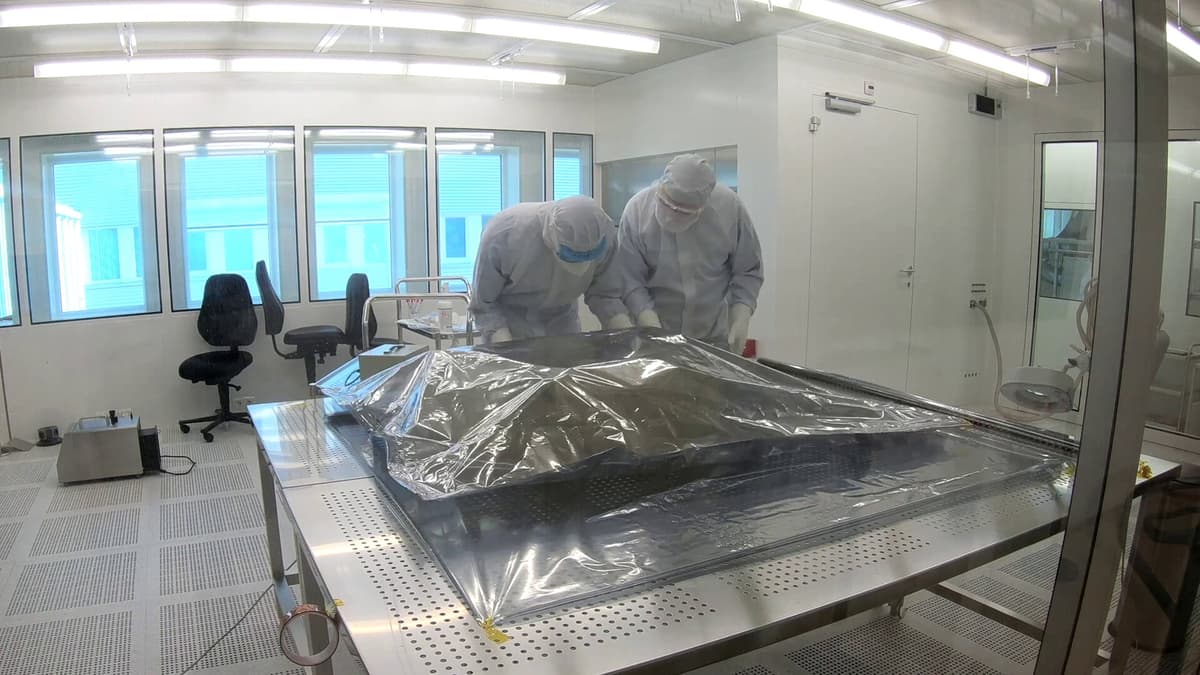
Baking a Parachute for Mars
Why It Matters
A contaminant‑free parachute protects the scientific validity of life‑search experiments and complies with international planetary‑protection treaties, preserving Mars for future exploration.
Key Takeaways
- •ESA sterilises 35‑m parachute to planetary protection standards.
- •Parachute weighs 74 kg, made of nylon and Kevlar.
- •It will be the largest parachute ever deployed beyond Earth.
- •Six‑minute descent will slow ExoMars rover for safe landing.
- •Sterilisation prevents forward contamination that could skew life‑search results.
Pulse Analysis
Designing the largest parachute ever flown beyond Earth presented unique engineering hurdles. The canopy’s 35‑meter diameter must unfold reliably in Mars’ thin atmosphere, delivering a controlled six‑minute deceleration that reduces the rover’s velocity from orbital speeds to a few meters per second. Constructed from a hybrid of nylon and Kevlar, the fabric balances tensile strength with low mass, while the donut‑shaped containment bag protects the material during transport and sterilisation. The specialised dry‑heat oven, equipped with two‑stage filtered airflow and strict gown‑in protocols, ensures uniform temperature exposure without compromising structural integrity.
The ExoMars Rosalind Franklin rover relies on a 35‑meter parachute that must meet the strictest planetary‑protection protocols. ESA’s Life Support and Physical Sciences Laboratory subjects the 74‑kg nylon‑Kevlar canopy to a six‑minute dry‑heat bake, achieving a cleanliness level ten thousand times greater than a typical smartphone. This rigorous sterilisation eliminates any terrestrial microbes that could survive the interplanetary journey, safeguarding the scientific integrity of the rover’s search for past or present Martian life. By preventing forward contamination, ESA upholds international treaties and preserves the pristine Martian environment for future exploration.
The parachute’s successful sterilisation is a prerequisite for the mission’s 2028 launch and its 25‑month cruise to Mars. Once on the Red Planet, the Rosalind Franklin rover will drill beneath the surface to analyse subsurface ice and sediment for biosignatures, a task that could be compromised by even a single Earth‑origin microbe. ESA’s meticulous approach not only protects scientific outcomes but also sets a benchmark for future planetary‑sample‑return and human‑exploration initiatives. As space agencies worldwide grapple with contamination risks, the ExoMars parachute exemplifies how rigorous engineering and planetary‑protection policy can coexist.
Baking a parachute for Mars
Comments
Want to join the conversation?
Loading comments...