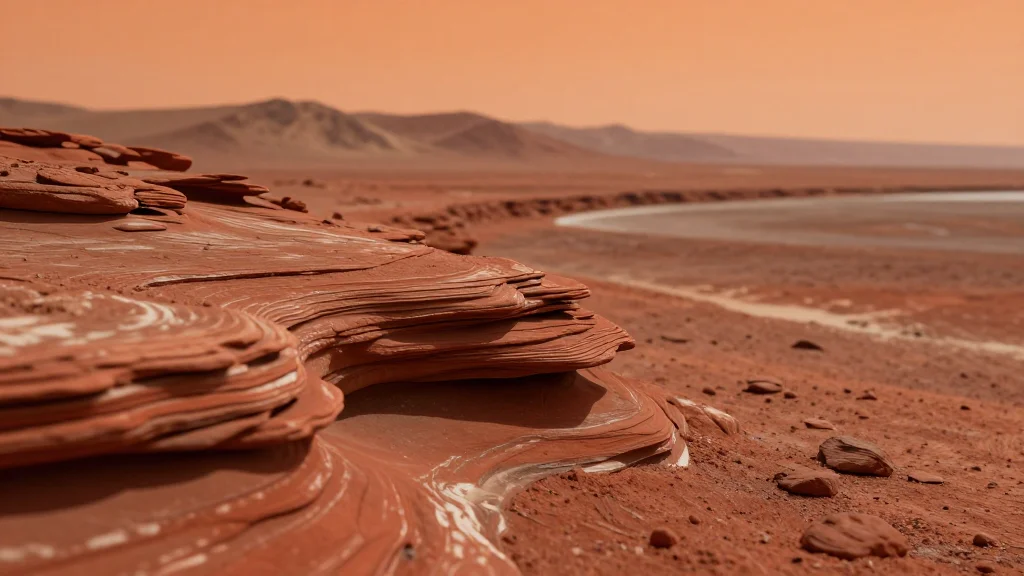
'Bathtub Ring' Hints at Ancient Martian Ocean
Why It Matters
A planetary‑scale ocean reshapes theories of Mars’ climate history and its potential to have hosted life, directing next‑generation missions toward sedimentary archives that could preserve biosignatures.
Key Takeaways
- •Caltech team identified a continental‑shelf‑like ring in Mars’ northern hemisphere
- •Ring suggests a stable ocean covering ~1/3 of Mars’ surface
- •Delta deposits align with the shelf, reinforcing ocean hypothesis
- •Findings guide future rover sites for potential biosignature preservation
- •Study uses Earth analogs and orbital topography to detect ancient seas
Pulse Analysis
The quest for water on Mars has long focused on isolated valleys and possible shoreline remnants, but those clues are often ambiguous because Martian topography has been reshaped by billions of years of erosion and volcanic activity. By turning to Earth’s own geological record, Zaki and Lamb pinpointed the continental shelf—a broad, relatively stable platform that persists long after sea levels fluctuate—as a more reliable indicator of ancient oceans. Their computer simulations “dried up” Earth’s oceans to isolate this feature, then applied the same analytical framework to high‑resolution orbital elevation data from the Red Planet.
The analysis revealed a continuous, low‑lying band encircling the northern lowlands, matching the expected dimensions of a shelf formed by a vast ocean that once spanned roughly 33 percent of Mars’ surface. The presence of deltaic deposits that terminate at this ring further strengthens the case, because deltas only form where rivers meet sizable bodies of water. This suggests the ocean persisted for millions of years, providing a stable environment that could have supported complex chemistry and, potentially, microbial life.
Beyond reshaping scientific narratives, the discovery offers concrete guidance for mission planners. Sedimentary layers along the identified shelf are prime candidates for preserving organic molecules, much like Earth’s coastal rocks retain fossil records. Future rovers equipped with drilling and spectrometry tools can target these deposits to search for biosignatures, while orbiters can refine the shelf’s geometry for precise landing site selection. In essence, the “bathtub ring” not only hints at a watery past but also maps a roadmap for the next chapter of Martian exploration.
'Bathtub ring' hints at ancient Martian ocean
Comments
Want to join the conversation?
Loading comments...