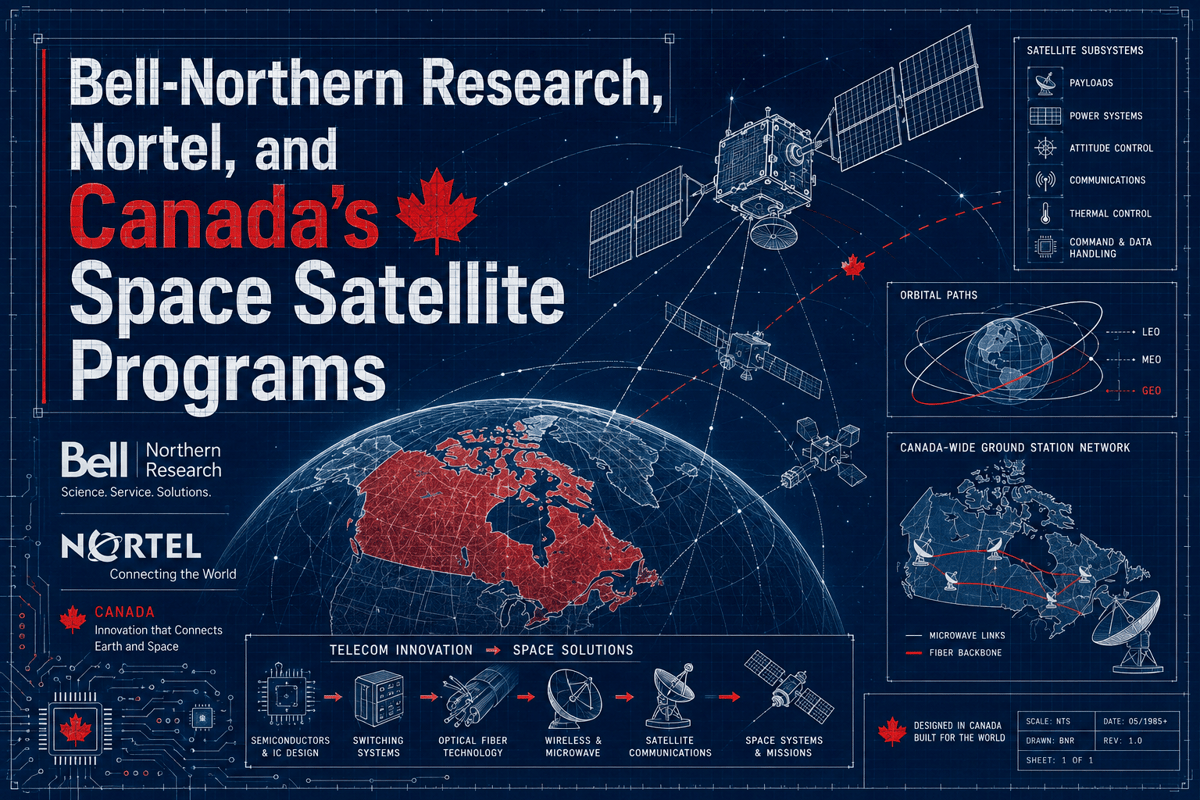
Bell-Northern Research, Nortel, and Canada’s Space Satellite Programs
Companies Mentioned
Why It Matters
The integration of satellite links with digital switching transformed Canada’s ability to deliver reliable voice, data, and TV services across its vast, sparsely populated regions, reinforcing the country’s strategic communications independence.
Key Takeaways
- •BNR’s research shaped Canada’s satellite‑network integration strategies.
- •Northern Telecom subcontracted on Anik A, linking switches to satellites.
- •Anik B test used DMS switches and BNR traffic simulator.
- •Spar Aerospace acquired Northern Telecom’s space assets, boosting Canadian satellite manufacturing.
- •Digital switching enabled reliable, nationwide satellite services for remote communities.
Pulse Analysis
Canada’s satellite story is often told through Telesat’s Anik fleet and the hardware expertise of Spar Aerospace, but the real value of those orbiting assets lay in how they were woven into the terrestrial network. In the 1970s, Bell‑Northern Research (BNR) began mapping the technical pathways that would let high‑frequency satellite beams feed directly into existing telephone exchanges. By studying multi‑beam SHF architectures and frequency‑reuse concepts, BNR provided the engineering blueprint that allowed Canada to move beyond the first‑generation 6/4 GHz Anik satellites toward more capable, higher‑capacity services.
The practical side of that blueprint emerged in the Anik B experiments, where Northern Telecom’s Digital Multiplex System (DMS) switches were paired with BNR’s traffic simulators and Telesat earth stations. The pilot demonstrated a 90 Mbps digital satellite link that could be managed by the same software‑controlled switches used in urban exchanges, proving that satellite capacity could be treated as just another node in a nationwide digital network. This integration was essential for serving remote northern communities, where laying fiber or microwave links would have been prohibitively expensive.
Beyond the immediate technical gains, the BNR‑Nortel partnership illustrates a broader lesson for today’s space economy: successful satellite services depend as much on ground‑segment innovation as on launch vehicles. By contributing research, industrial subcontracting, and critical network equipment, BNR and Nortel helped Canada build a resilient communications layer that leveraged space assets for everyday use. As modern constellations and 5G/6G networks converge, the historical model of telecom‑centric satellite integration offers a roadmap for turning raw orbital capacity into reliable, user‑focused services.
Bell-Northern Research, Nortel, and Canada’s Space Satellite Programs
Comments
Want to join the conversation?
Loading comments...