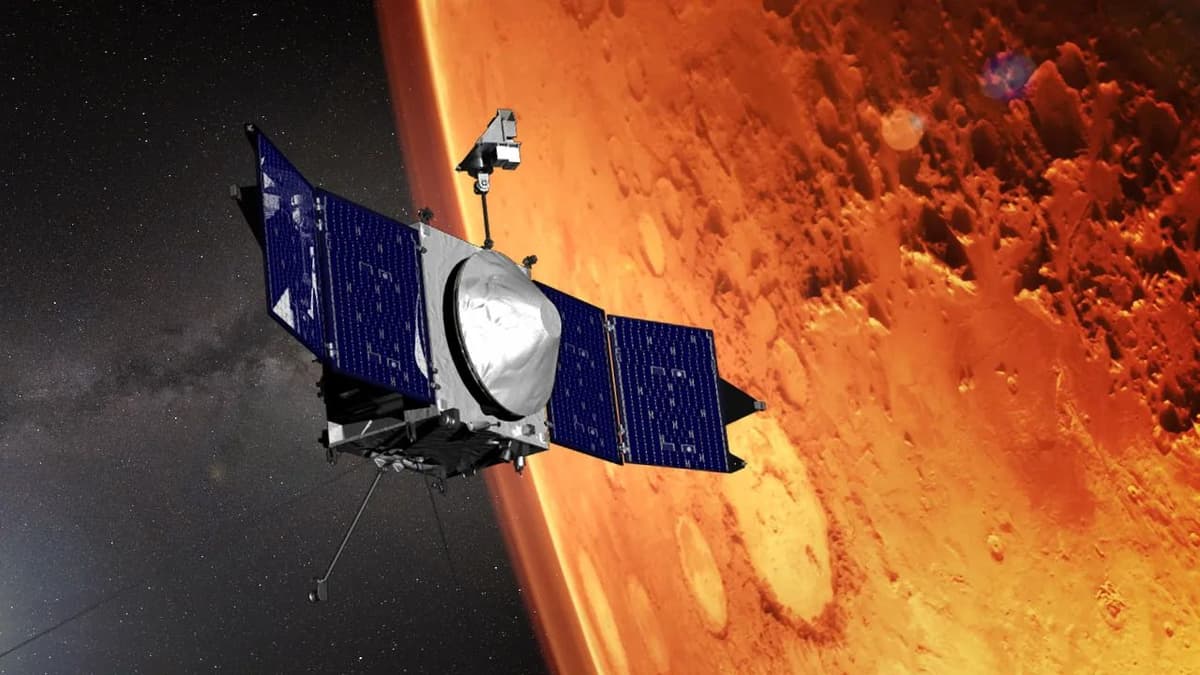
'Best. Mars. Mission. Ever.' Scientists Hail MAVEN's Legacy as NASA Retires Red Planet Orbiter
Companies Mentioned

Why It Matters
MAVEN’s scientific breakthroughs reshaped our understanding of atmospheric loss on Mars, while its communications role was vital for surface missions. Its loss underscores the need for resilient, next‑generation relay infrastructure as Mars exploration intensifies.
Key Takeaways
- •MAVEN operated 11 years, exceeding its 2‑year design life
- •Provided over 800 scientific papers and 18% of Mars surface data
- •Unexpected spin caused battery drain, leading to loss of signal
- •Retirement creates modest gap in Mars communications network
- •NASA exploring commercial relay network to replace MAVEN’s capacity
Pulse Analysis
MAVEN’s decade‑long observations transformed planetary science by quantifying how solar storms and atmospheric sputtering strip gases from Mars. The mission proved that atmospheric escape is a dynamic, solar‑driven process, offering the clearest picture yet of why the Red Planet transitioned from a wet world to today’s arid landscape. Researchers continue to cite its findings in studies of exoplanet habitability, cementing MAVEN as a cornerstone of comparative planetology.
Beyond its scientific payload, MAVEN served as a high‑capacity communications hub, relaying nearly one‑fifth of all data from rovers and landers. Its loss introduces occasional delays in data retrieval, but the remaining orbiters—Odyssey, MRO, Mars Express, and TGO—maintain a resilient network. NASA’s immediate response includes re‑tasking these assets and accelerating plans for a commercial Mars telecom constellation, ensuring continuous support for upcoming missions like ESCAPADE and future sample‑return endeavors.
Looking forward, MAVEN’s unexpected spin‑induced failure highlights the importance of robust fault‑tolerance and power‑management designs for long‑duration orbiters. The agency’s push toward a private‑sector‑led relay architecture aims to diversify risk and expand bandwidth, lessons directly drawn from MAVEN’s legacy. As the spacecraft will linger in Martian orbit for decades, it also serves as a reminder that even retired probes can inform future engineering and scientific strategies.
'Best. Mars. Mission. Ever.' Scientists hail MAVEN's legacy as NASA retires Red Planet orbiter
Comments
Want to join the conversation?
Loading comments...