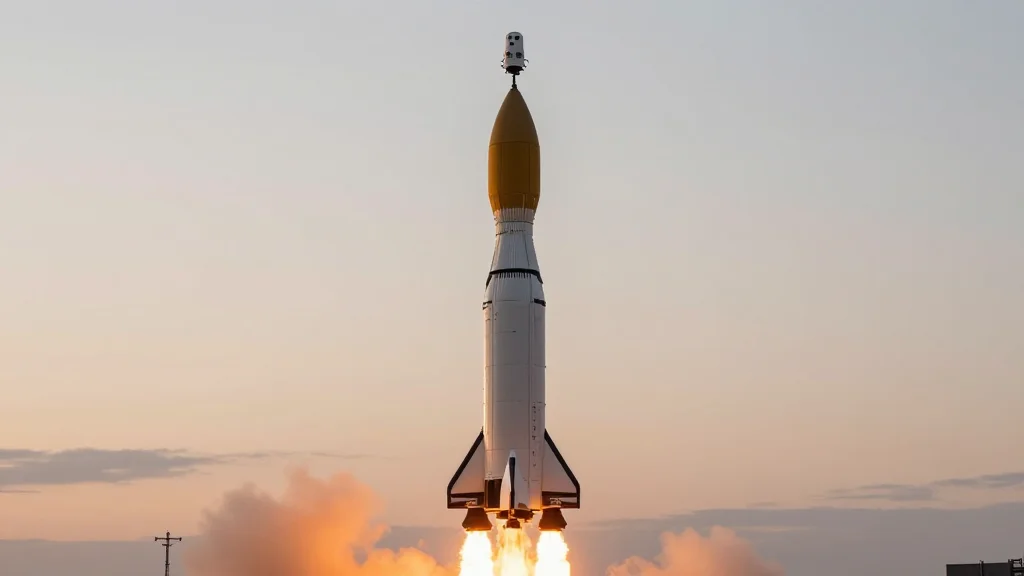
Big Badaboom: The Effects of a Saturn V Launch Pad Explosion
Why It Matters
Understanding the worst‑case explosion scenario informs launch‑pad design, abort system requirements, and risk mitigation for modern super‑heavy rockets, protecting crew and infrastructure.
Key Takeaways
- •Saturn V explosion yield ~543,000 kg TNT (≈0.5 kt) theoretical max
- •Likely yield estimated at 300‑400 tons TNT (≈0.3‑0.4 kt)
- •Overpressure >5 psi would destroy Apollo capsule; escape distance 274 m
- •Tower collision identified as primary cause of on‑pad explosion risk
- •LES designed for 33.9‑second fireball reaching ~1,370 °C
Pulse Analysis
During the Apollo era NASA commissioned a series of hazard studies to answer a stark question: what would happen if a fully‑fuelled Saturn V detonated on the pad? The 1963 "Saturn V Booster Explosion Hazards and Apollo Survivability Analyses" translated propellant masses into TNT equivalents, revealing a maximum blast energy of roughly half a kiloton. Over‑pressure thresholds above five pounds per square inch were deemed fatal to the Command Module, dictating a minimum 274‑meter clearance for the Launch Escape System to function. These calculations also highlighted that only a fraction of the propellant would likely burn, tempering the worst‑case estimates.
The technical reports delved deeper into the dynamics of a pad‑side fireball, estimating a 33.9‑second radiant event with surface temperatures near 1,370 °C. Such a fireball could jeopardize parachute shroud lines on a descending capsule, prompting engineers to refine LES thrust profiles and sensor triggers. Simultaneously, NASA identified tower‑collision during liftoff as the most plausible ignition source, prompting rigorous analysis of hold‑down arm release timing, engine gimbal limits, and wind‑induced disturbances. By modeling seven potential perturbations, the studies concluded that only a combination of a malfunction—such as an engine hard‑over—and adverse external factors could drive the rocket into the tower.
Decades later, the legacy of these investigations resonates in the design of contemporary super‑heavy launchers like SpaceX’s Starship, Blue Origin’s New Glenn, and NASA’s SLS. Modern programs inherit the same safety imperatives: robust abort systems, real‑time tower‑collision detection, and fireball mitigation strategies. The historical data serve as a benchmark, ensuring that the explosive potential of today’s larger propellant loads is rigorously quantified and that crew‑survival architectures are engineered to survive an event that, in the 1960s, was likened to a small atomic bomb.
Big badaboom: the effects of a Saturn V launch pad explosion
Comments
Want to join the conversation?
Loading comments...