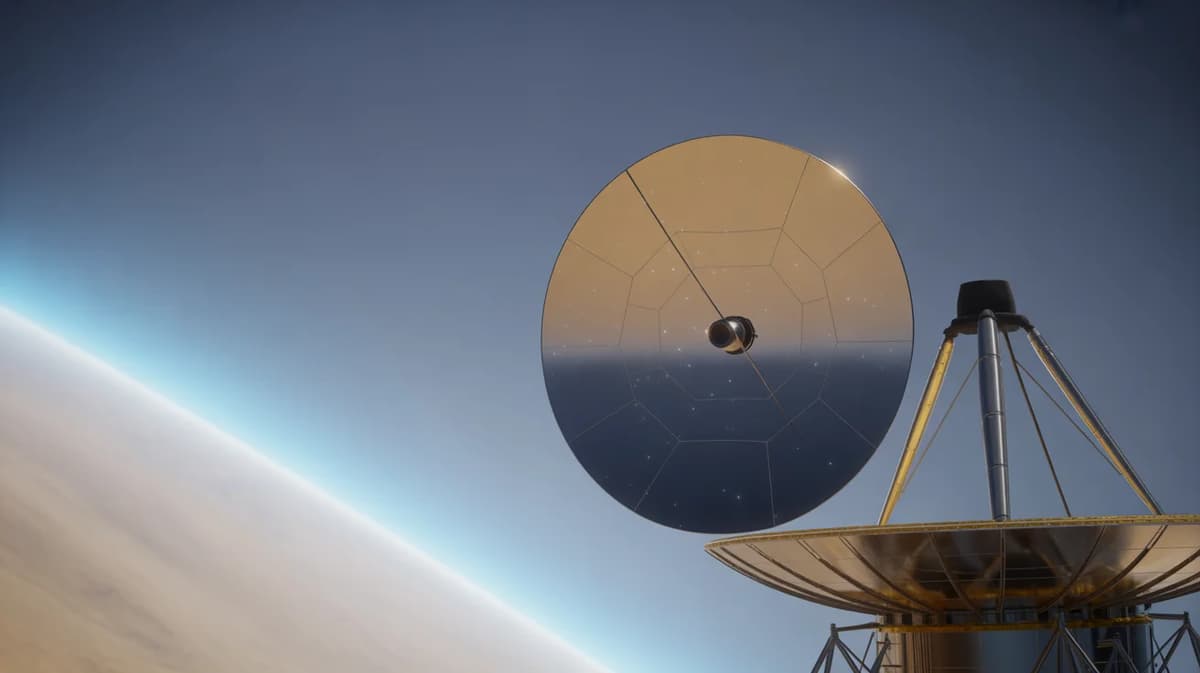
Billionaire to Fund Construction of an Orbiting Optical Telescope Larger than Hubble
•January 8, 2026
0
Companies Mentioned


Why It Matters
Private, billionaire‑backed funding revives a fast‑track model for large‑scale astronomy, potentially accelerating breakthroughs that government programs have delayed. Open access ensures worldwide scientific benefit and new market dynamics in space infrastructure.
Key Takeaways
- •Lazuli's 3.1‑meter mirror exceeds Hubble's size
- •Private funding targets rapid development, under‑decade launch
- •Open‑time policy grants global scientists telescope access
- •Three instruments enable exoplanet imaging and transient studies
- •Lunar‑resonant orbit provides unprecedented rapid target response
Pulse Analysis
The Schmidt Sciences initiative marks a watershed moment in astronomical research, re‑introducing a philanthropic funding model that predates the post‑World War II government monopoly. By allocating hundreds of millions of dollars without congressional approval, the Schmidts can bypass lengthy NASA budgeting cycles, allowing the Lazuli telescope to move from concept to launch in under a decade. This agility mirrors the early 20th‑century era when private patrons built the world’s largest observatories, fostering competition and innovation across the sector.
Technically, Lazuli’s 3.1‑meter primary mirror and its suite of instruments position it as a versatile successor to Hubble. Operating from a 3:1 lunar‑resonant orbit, the telescope can swivel to new targets within four hours, a capability crucial for time‑domain and multi‑messenger astronomy such as gravitational‑wave counterpart follow‑ups. Its coronagraph will suppress starlight to reveal faint exoplanets, while the infrared spectrograph enables atmospheric composition studies, expanding the scientific reach beyond traditional optical imaging.
The broader market implications are significant. Open‑time access democratizes data, encouraging collaborations between universities, startups, and established aerospace firms. As private capital proves capable of delivering flagship‑class hardware, investors may view space‑based observatories as viable commercial assets, spurring a new wave of venture‑backed missions. This shift could reshape NASA’s role, prompting the agency to focus on niche, high‑risk projects while the private sector tackles large‑scale, general‑purpose telescopes, ultimately accelerating the pace of discovery across astrophysics.
Billionaire to fund construction of an orbiting optical telescope larger than Hubble
0
Comments
Want to join the conversation?
Loading comments...