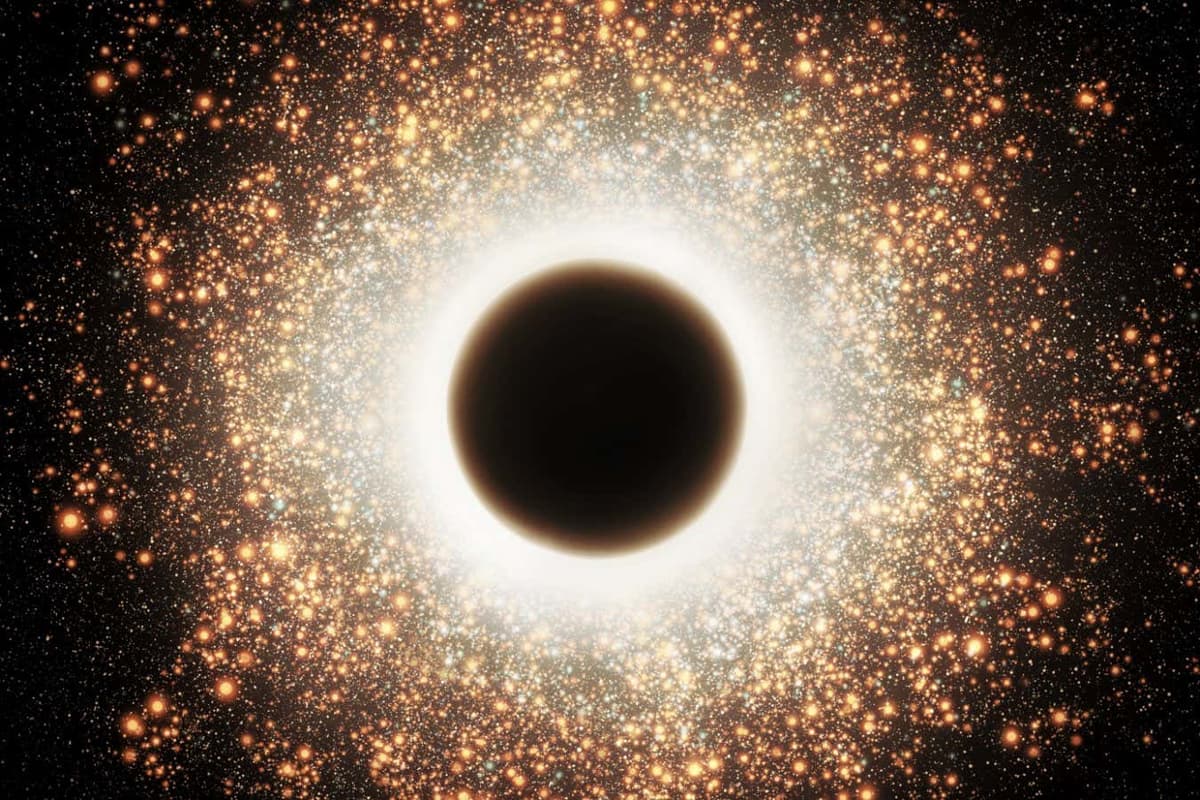
Black Hole Stars Really Do Exist in the Early Universe
•December 22, 2025
0
Companies Mentioned

Why It Matters
The finding provides a plausible mechanism for the rapid emergence of supermassive black holes, reshaping theories of early galaxy formation and cosmic structure growth.
Key Takeaways
- •JWST identified compact red dots in first billion years
- •Study reveals they are black holes cloaked in gas
- •Gas envelopes emit star-like light, mimicking galaxies
- •Findings reshape models of early black hole growth
- •May explain rapid supermassive black hole formation
Pulse Analysis
The James Webb Space Telescope’s unprecedented infrared sensitivity has opened a window onto the universe’s infancy, revealing objects that defy conventional classification. Among these, the so‑called little red dots appeared as ultra‑compact, luminous sources that could not be reconciled with known galaxy templates. By combining high‑resolution imaging with spectroscopic diagnostics, researchers uncovered that each dot hosts a black hole enshrouded in a dense, ionized gas sphere. The gas, heated by accretion processes, radiates intensely, producing a star‑like glow that mimics the appearance of a nascent galaxy.
This revelation carries profound implications for astrophysical models of black hole seed formation. Traditional theories struggled to explain how supermassive black holes reached billions of solar masses within a few hundred million years after the Big Bang. The gas‑rich, radiatively efficient environment identified around these early black holes offers a natural pathway for rapid mass accumulation, bypassing the need for exotic seed mechanisms. Moreover, the luminous envelopes can dominate the host’s spectral signature, potentially masking the underlying galaxy and leading to misinterpretations of early‑universe surveys.
Beyond the immediate astrophysical insights, the discovery underscores the transformative power of JWST in redefining cosmic narratives. It prompts a reevaluation of early‑epoch luminosity functions, star‑formation rate estimates, and the timeline of reionization. As follow‑up observations target these black‑hole‑star hybrids across different redshifts, the community anticipates refined constraints on the interplay between black hole growth and galaxy assembly, shaping the next generation of cosmological simulations.
Black hole stars really do exist in the early universe
0
Comments
Want to join the conversation?
Loading comments...