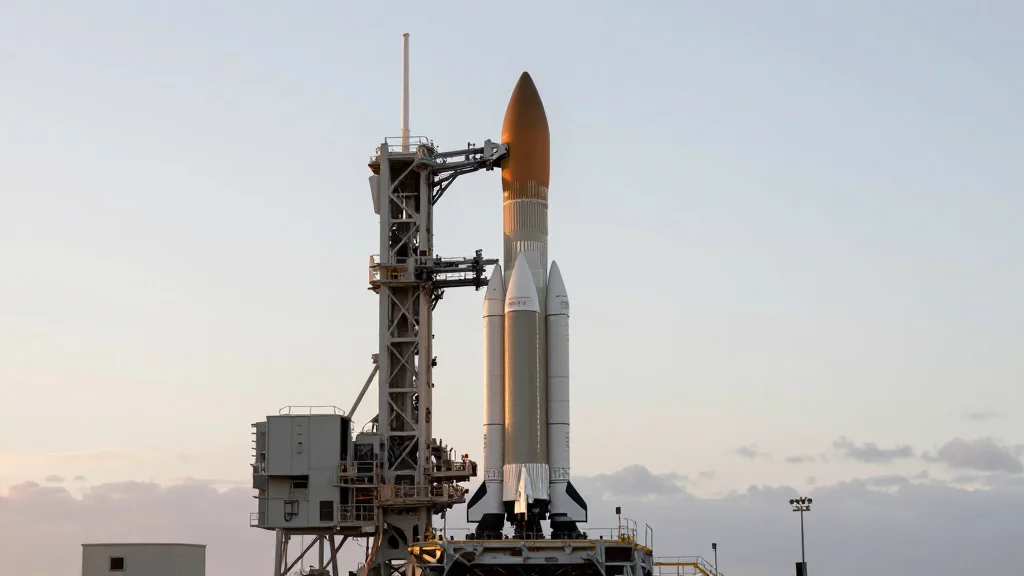
Blue Origin Readies New Glenn for Third Cape Canaveral Launch, Targeting April 16

Companies Mentioned

Why It Matters
Blue Origin’s third New Glenn launch marks a pivotal moment for U.S. launch competition, signaling that the market is no longer dominated by a single provider. By integrating a commercial satellite payload and targeting reusable booster recovery, Blue Origin is positioning itself as a viable alternative for both commercial operators and government agencies, potentially driving down launch costs and increasing schedule flexibility. The mission also ties directly into NASA’s Artemis lunar exploration strategy. Successful deployment of the Blue Moon lander from New Glenn would demonstrate the vehicle’s capability to support deep‑space missions, expanding the pool of launch options for future lunar and Mars endeavors and reducing reliance on SpaceX’s Starship and Falcon 9 platforms.
Key Takeaways
- •Blue Origin has placed New Glenn on LC‑36 for a launch no earlier than 6:45 a.m. April 16
- •The rocket will carry AST SpaceMobile’s Block 2 BlueBird satellite, already integrated
- •New Glenn is 321 feet tall, just one foot shorter than NASA’s SLS and larger than SpaceX’s Falcon 9
- •The mission includes a planned sea‑based first‑stage booster landing, mirroring the November 2025 recovery
- •Blue Origin’s launch supports NASA’s Artemis lunar lander program and expands U.S. heavy‑lift competition
Pulse Analysis
Blue Origin’s push to operationalize New Glenn reflects a strategic shift from a test‑centric program to a revenue‑driven launch service. The company’s ability to secure a commercial payload—AST SpaceMobile’s broadband satellite—signals market confidence that the vehicle can meet the performance and reliability standards demanded by satellite operators. This is a critical inflection point; historically, Blue Origin’s orbital ambitions have been hampered by delays and cost overruns, allowing SpaceX to capture the bulk of commercial contracts. A successful launch and booster recovery would not only validate New Glenn’s reusability claim but also provide a tangible cost‑competitiveness argument against Falcon 9, especially for large payloads that benefit from New Glenn’s higher lift capacity.
From a policy perspective, the launch reinforces the U.S. government’s broader goal of maintaining multiple domestic heavy‑lift providers. NASA’s Artemis program explicitly calls for redundancy, and Blue Origin’s involvement with the Blue Moon lander adds a second viable lunar lander architecture alongside SpaceX’s Starship HLS. This redundancy reduces program risk and could accelerate the timeline for returning humans to the Moon. Moreover, the presence of a commercial payload on a NASA‑aligned launch vehicle showcases a hybrid model where government and commercial interests converge, potentially unlocking new funding streams and partnership models.
Looking ahead, the outcome of the hot‑fire test and the booster landing will be the decisive factors that shape New Glenn’s market trajectory. A clean test and successful recovery would likely trigger a surge in launch bookings, as satellite operators and defense customers seek alternatives to SpaceX’s pricing. Conversely, any anomalies could delay the vehicle’s entry into regular service, giving SpaceX additional headroom to cement its dominance. In either scenario, Blue Origin’s third flight is a bellwether for the next phase of U.S. launch competition, with implications that extend beyond the immediate payload to the broader architecture of America’s space launch ecosystem.
Blue Origin readies New Glenn for third Cape Canaveral launch, targeting April 16
Comments
Want to join the conversation?
Loading comments...