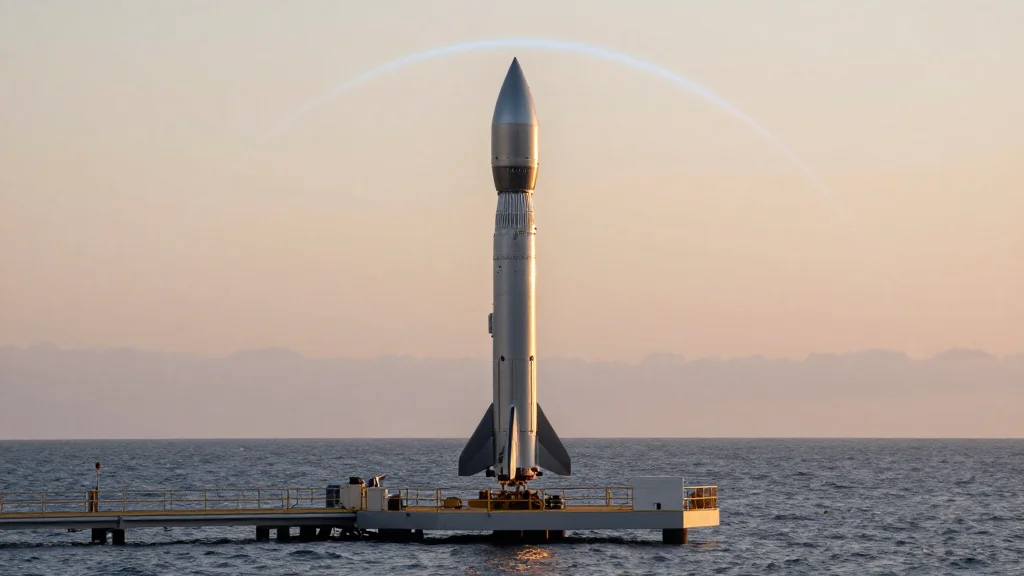
Blue Origin Recovers New Glenn First Stage but Loses AST SpaceMobile Satellite to Wrong Orbit

Companies Mentioned

Why It Matters
The NG‑3 mission illustrates that achieving reusable launch hardware is only part of the equation; payload integrity remains a decisive factor for commercial customers. A successful booster recovery can lower launch costs, but a failed payload insertion erodes confidence and can delay critical infrastructure projects like AST SpaceMobile’s broadband network. The incident also sharpens the competitive dynamics among heavy‑lift providers, forcing Blue Origin to prove that its reuse model can deliver both cost efficiency and mission reliability. For the broader SpaceTech ecosystem, the event signals that investors and customers will demand integrated performance metrics that encompass both hardware reuse rates and payload success percentages. As the market moves toward higher launch frequencies, any perceived reliability gap could shift future contracts toward providers with proven end‑to‑end track records, influencing the allocation of capital across the sector.
Key Takeaways
- •Blue Origin successfully landed the reused first stage of New Glenn on April 19, 2026 (NG‑3 mission).
- •Upper‑stage anomaly placed AST SpaceMobile’s 6,100‑kg BlueBird 7 satellite into the wrong orbit.
- •The payload loss threatens AST SpaceMobile’s 2026 direct‑to‑cell broadband rollout.
- •New Glenn’s launch price is roughly $70 million, competing with Falcon 9 and Vulcan.
- •Blue Origin has not announced the next New Glenn launch date, pending investigation results.
Pulse Analysis
Blue Origin’s mixed NG‑3 results highlight a pivotal inflection point for the company’s reusability strategy. The successful first‑stage recovery demonstrates that the engineering challenges of a 70‑meter heavy‑lift booster can be overcome, narrowing the gap with SpaceX’s operational tempo. However, the upper‑stage failure reveals a systemic risk: reusability alone does not guarantee mission success. Customers like AST SpaceMobile are less tolerant of orbital insertion errors because their business models depend on precise constellation geometry and timing. This creates a market niche for launch providers that can bundle reuse with a proven upper‑stage reliability record.
From a financial perspective, the incident could pressure Blue Origin’s pricing power. While a $70 million launch fee is competitive, any perception of higher failure risk may compel customers to accept higher‑priced but more reliable alternatives, especially for high‑value broadband payloads. The company’s ability to quickly return to flight with a clean bill of health will be critical to maintaining its launch manifest and securing future contracts from both government and commercial customers.
Looking ahead, the next New Glenn flight will serve as a litmus test for the company’s integrated reliability. If Blue Origin can pair a recovered booster with a flawless payload delivery, it will reinforce the economic case for heavy‑lift reuse and potentially accelerate the adoption of large‑scale satellite constellations. Conversely, a repeat of the NG‑3 outcome could accelerate a shift toward smaller, expendable launch vehicles for high‑precision missions, reshaping the competitive landscape of the SpaceTech launch market.
Blue Origin recovers New Glenn first stage but loses AST SpaceMobile satellite to wrong orbit
Comments
Want to join the conversation?
Loading comments...