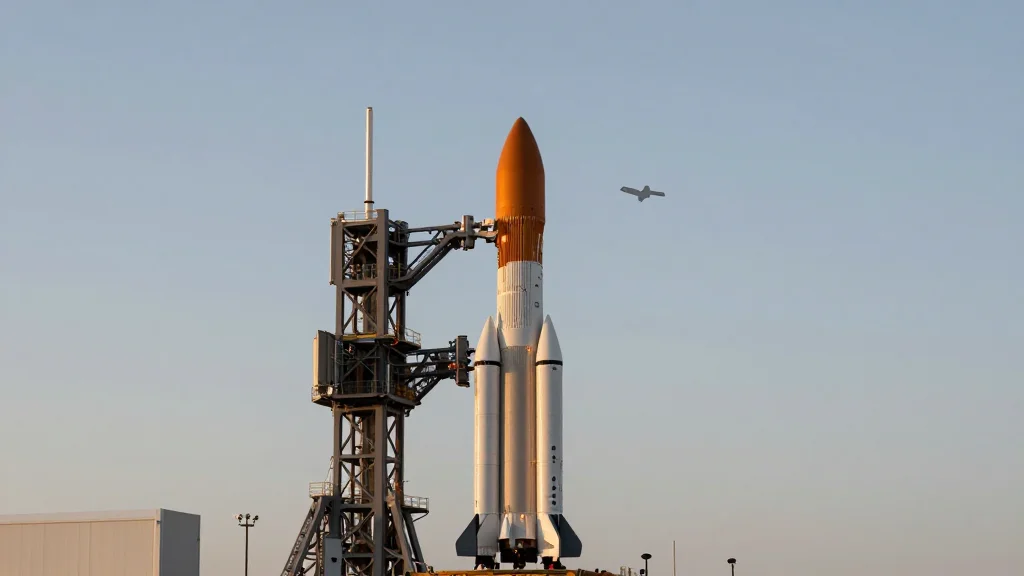
Blue Origin Sets Sunday New Glenn Launch with AST SpaceMobile Broadband Satellite

Companies Mentioned

Why It Matters
The NG‑3 mission is a litmus test for Blue Origin’s strategy to blend heavy‑lift capability with commercial broadband services, a market currently dominated by SpaceX. Successful deployment and booster recovery would validate a lower‑cost, high‑frequency launch model, potentially reshaping the economics of satellite constellations and accelerating the rollout of space‑based internet. For the broader SpaceTech ecosystem, the launch signals a maturing market where multiple providers can offer reusable heavy‑lift options. This competition could drive down launch prices, spur innovation in satellite design, and expand global connectivity, especially in underserved regions that stand to benefit from direct‑to‑smartphone broadband.
Key Takeaways
- •Blue Origin schedules Sunday, April 19 launch of New Glenn NG‑3 from Launch Complex 36.
- •Mission carries AST SpaceMobile’s BlueBird 7 broadband satellite, targeting service rollout in 2026.
- •First‑stage booster “Never Tell Me The Odds” will attempt sea‑based recovery on the cargo ship Jacklyn.
- •BlueBird 7 features nearly 2,400 sq ft of antenna array to deliver 4G/5G speeds directly to smartphones.
- •Successful recovery would bolster Blue Origin’s reusability credentials against SpaceX’s Falcon 9 dominance.
Pulse Analysis
Blue Origin’s New Glenn has long been positioned as a challenger to SpaceX’s Falcon 9, but the NG‑3 mission is the first to combine a high‑value commercial payload with a reusable heavy‑lift architecture. The stakes are high: a successful booster recovery could prove that New Glenn’s larger first stage can be turned over quickly and cheaply, a prerequisite for competing on price and cadence. Historically, SpaceX’s rapid turnaround—often under 30 days—has set the industry benchmark. Blue Origin’s approach, using a dedicated autonomous ship and advanced inspection regimes, suggests a different operational philosophy that may prioritize safety and component longevity over sheer speed.
The inclusion of AST SpaceMobile’s BlueBird 7 also reflects a strategic pivot toward the lucrative satellite‑based broadband sector. While SpaceX’s Starlink already commands a massive user base, the direct‑to‑smartphone model pursued by AST could open new revenue streams by bypassing ground‑based towers. If BlueBird 7 validates its performance, it could attract other telecom players seeking similar capabilities, thereby diversifying Blue Origin’s customer base beyond traditional satellite operators.
Looking ahead, the outcome of NG‑3 will influence investor confidence and future launch contracts. A clean recovery and successful payload deployment could accelerate the scheduling of NG‑4 and NG‑5 missions, potentially drawing government and defense contracts that require heavy‑lift capacity. Conversely, any setback may reinforce the perception that New Glenn’s reusability is still experimental, giving SpaceX an even larger lead. In either scenario, the launch underscores the intensifying competition in the SpaceTech arena, where reusable rockets and broadband satellites are converging to reshape how humanity accesses space and connectivity.
Blue Origin Sets Sunday New Glenn Launch with AST SpaceMobile Broadband Satellite
Comments
Want to join the conversation?
Loading comments...