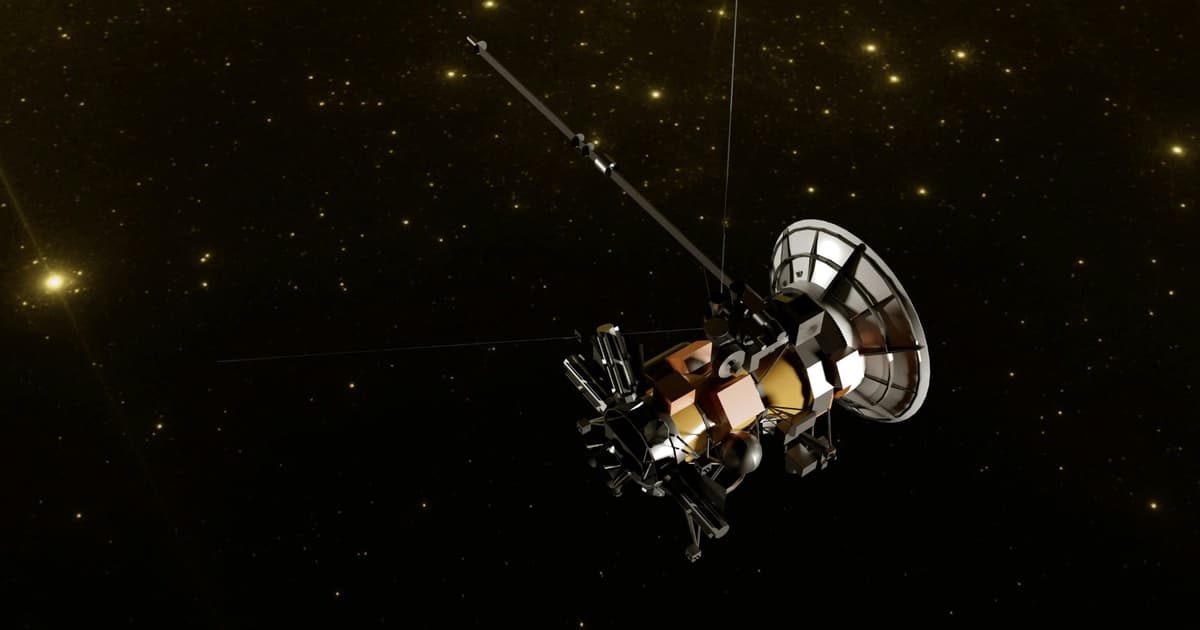
Bolted to Pioneer 10 Is a Plaque Showing Two Humans and a Cosmic Map Back to Earth, While the Spacecraft Itself Is Now a Silent Ghost Ship Drifting Toward Aldebaran, a Star It Will Not Pass for Another Two Million Years.
Why It Matters
The story highlights the limits of early interstellar messaging and underscores how legacy artifacts become symbols of human ambition rather than functional beacons. It also reminds policymakers that future deep‑space probes will outlive their power sources, turning into silent ambassadors of our era.
Key Takeaways
- •Pioneer 10 carries a gold‑anodised plaque with human figures and pulsar map
- •Last telemetry received January 2003; probe now silent and untracked
- •Drifts toward Aldebaran, but will not reach it for ~2 million years
- •Aldebaran’s motion makes "heading for" a directional approximation
- •Plaque serves more as cultural statement than practical interstellar message
Pulse Analysis
The Pioneer 10 mission, launched on 2 March 1972, was a milestone in planetary exploration, becoming the first probe to cross the asteroid belt and fly past Jupiter. Beyond its scientific payload, it carried a gold‑anodised aluminium plaque designed by Carl Sagan, Frank Drake, and artist Linda Salzman Sagan. The plaque features stylized human figures and a radial diagram of fourteen pulsars, offering a cosmic map and timestamp for any hypothetical finder. While the spacecraft’s primary mission ended in 1997, its legacy endures through this emblem of humanity’s desire to communicate across the void.
After more than two decades of transmitting data, Pioneer 10’s radioisotope thermoelectric generators dwindled, and the last faint signal was recorded in January 2003. With power exhausted, the probe now coasts silently, its position inferred from orbital mechanics rather than direct tracking. Its trajectory points roughly toward Aldebaran, a star about 68 light‑years away, but the two‑million‑year travel estimate assumes the star remains stationary—a simplification that ignores stellar motion. Consequently, the probe is not on a collision course; it merely drifts in the general direction of a distant horizon.
The plaque’s durability was engineered for the harsh interstellar environment, yet micrometeoroid impacts and cosmic radiation will eventually erode its surface. More importantly, the odds of any civilization encountering a car‑sized object in interstellar space are astronomically low. The true value of Pioneer 10’s message lies in its symbolic role: a 1972 declaration that humanity could launch objects beyond the solar system and contemplate its place in the cosmos. As future missions consider more sophisticated interstellar beacons, the Pioneer plaque remains a reference point for balancing scientific ambition with cultural expression.
Bolted to Pioneer 10 is a plaque showing two humans and a cosmic map back to Earth, while the spacecraft itself is now a silent ghost ship drifting toward Aldebaran, a star it will not pass for another two million years.
Comments
Want to join the conversation?
Loading comments...