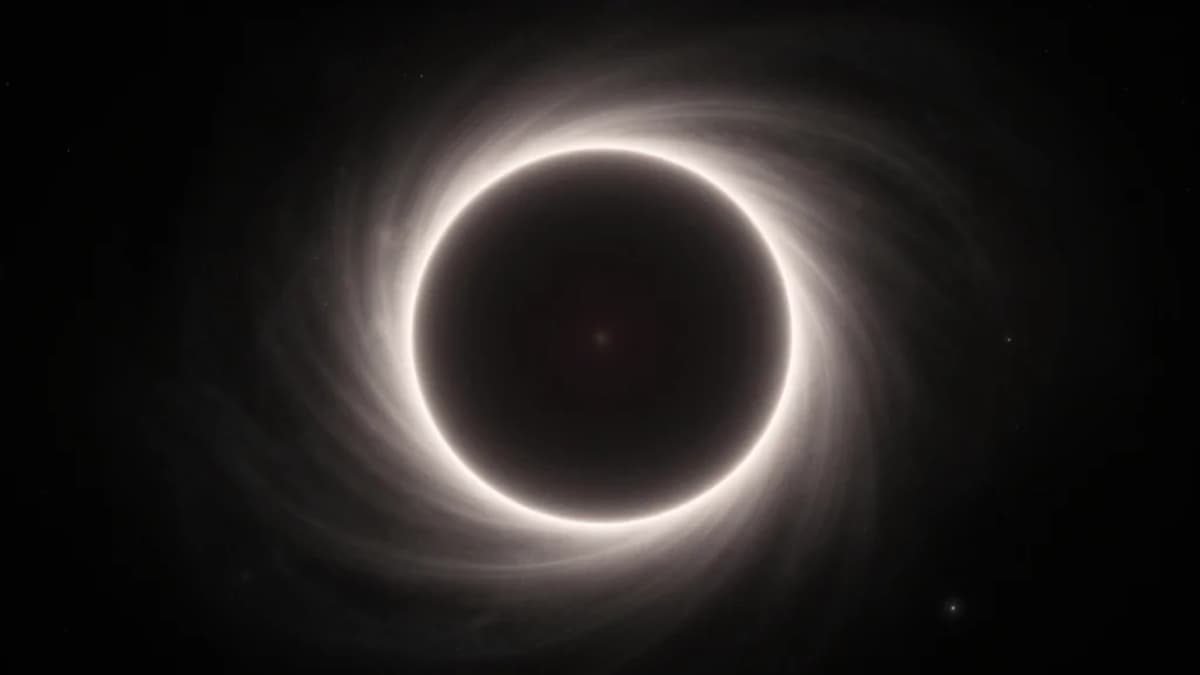
Bright Supernova Offers New View of Black Hole Birth
•January 13, 2026
0
Why It Matters
It shows black‑hole formation can produce bright electromagnetic signals, providing a new observable pathway to study progenitors of gravitational‑wave sources. This insight refines models of massive star evolution and binary black‑hole formation.
Key Takeaways
- •SN 2022esa is a type Ic‑CSM supernova.
- •Explosion linked to Wolf‑Rayet star in close binary.
- •Light curve shows one‑month stable brightness period.
- •Findings suggest black‑hole binaries can form from such systems.
- •Coordinated Seimei and Subaru observations enabled deep late‑phase data.
Pulse Analysis
The birth of stellar‑mass black holes has long been considered a silent affair, hidden behind the darkness of a collapsing core. Traditional models predict that the most massive stars collapse directly into black holes without a luminous supernova, leaving astronomers with few electromagnetic clues. SN 2022esa overturns that paradigm by delivering a bright, type Ic‑CSM explosion that can be monitored across the electromagnetic spectrum, opening a new window into the final moments of massive stars.
Using the rapid‑response capabilities of Japan’s Seimei telescope and the deep‑imaging power of the Subaru 8‑meter instrument, researchers traced SN 2022esa from its peak brightness through a year‑long fade. The light curve displayed a remarkably stable one‑month plateau, and late‑time spectra revealed signatures of dense circumstellar material, hallmarks of a Wolf‑Rayet progenitor undergoing periodic eruptions. These periodic outbursts strongly suggest a close binary configuration, likely involving another massive star or an existing black‑hole companion. Such binary systems are the progenitors of the merging black‑hole pairs detected by LIGO and Virgo, linking a visible supernova to future gravitational‑wave events.
The broader implication is a shift in how the astrophysics community approaches transient surveys. Coordinated observations that blend rapid follow‑up with high‑sensitivity spectroscopy can capture fleeting phenomena that single‑facility campaigns miss. As more facilities adopt this collaborative model, we can expect a richer catalog of luminous black‑hole births, refining population synthesis models and improving predictions for gravitational‑wave event rates. This synergy not only deepens our understanding of massive star evolution but also strengthens the bridge between electromagnetic astronomy and multimessenger astrophysics.
Bright supernova offers new view of black hole birth
0
Comments
Want to join the conversation?
Loading comments...