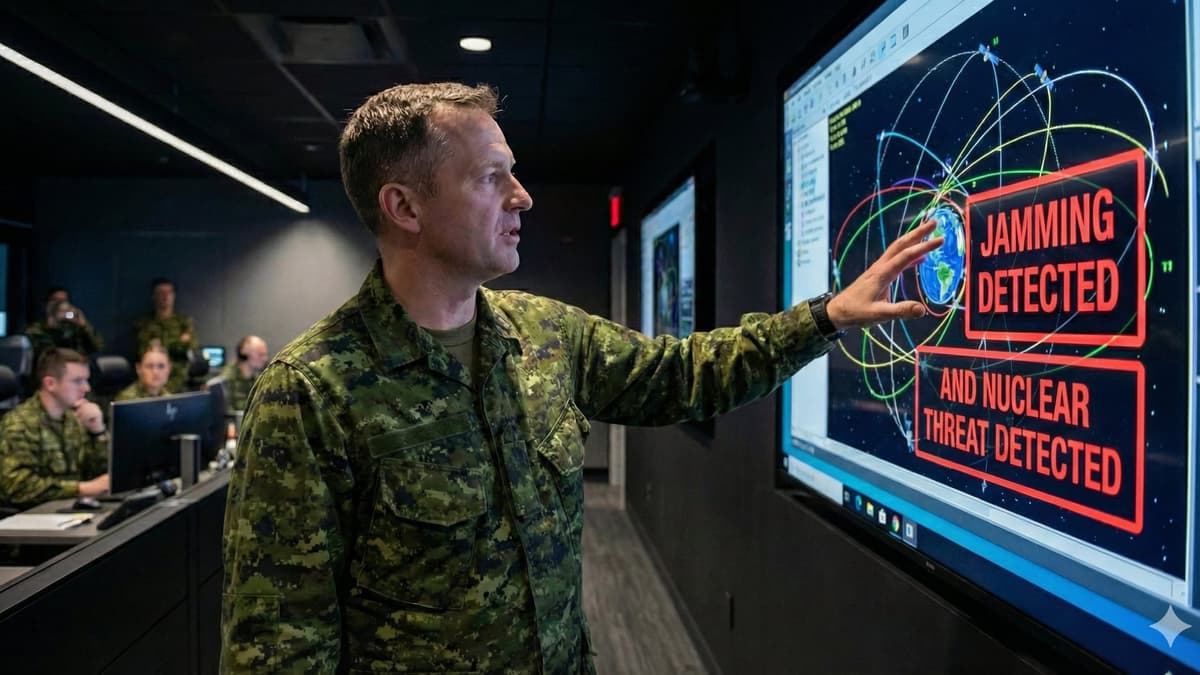
Canada’s Space Commander on Protecting Satellites From Jamming and Potential Nuclear Risks
•March 3, 2026
0
Companies Mentioned
Why It Matters
The potential loss of satellite‑based communications, navigation and financial networks would cripple both civilian and military operations, making space resilience a national security priority. Canada’s investment and alliance‑based approach aim to safeguard its economy and uphold the rules‑based international order.
Key Takeaways
- •Nuclear EMP in LEO could disable global satellite networks
- •Russia's jamming already reaches low Earth orbit
- •Canada allocated $183 million for sovereign launch capability
- •Canada favors diplomacy over counter‑weapon development for space threats
- •Resilience requires hardening infrastructure and independent satellite launches
Pulse Analysis
The specter of an electromagnetic pulse (EMP) from a nuclear device detonated in low‑Earth orbit has moved from science‑fiction to a credible strategic risk. An EMP can fry the delicate electronics of satellites, wiping out GPS, communications and financial transaction networks that underpin modern economies. Such a blackout would ripple through everything from ride‑hailing apps to emergency response coordination, underscoring why governments are now treating space as a critical infrastructure domain rather than a peripheral frontier.
While the ultimate EMP scenario remains a worst‑case, the immediate threat is already materialising through aggressive electronic‑warfare. Russia’s jamming operations, honed in the Ukraine conflict, have begun to spill over into the orbital arena, disrupting services of commercial constellations like Starlink and Viasat. This saturation of interference erodes the reliability of private and public satellite assets, prompting operators to invest in signal hardening and redundancy. The trend signals a shift where space is no longer a peaceful commons but a contested battleground where even non‑kinetic attacks can have strategic consequences.
Canada’s response blends fiscal commitment with diplomatic restraint. The recent $183 million allocation funds the development of indigenous launch capabilities, ensuring the nation can deploy and replace satellites without reliance on foreign providers during a crisis. Simultaneously, Canadian officials, led by Horner, advocate for rules‑based governance and pressure against the weaponisation of space, rather than pursuing offensive counter‑measures. This dual strategy aims to protect national security, preserve economic interests tied to the space economy, and reinforce Canada’s role as a middle power championing responsible use of the final frontier.
Canada’s space commander on protecting satellites from jamming and potential nuclear risks
0
Comments
Want to join the conversation?
Loading comments...