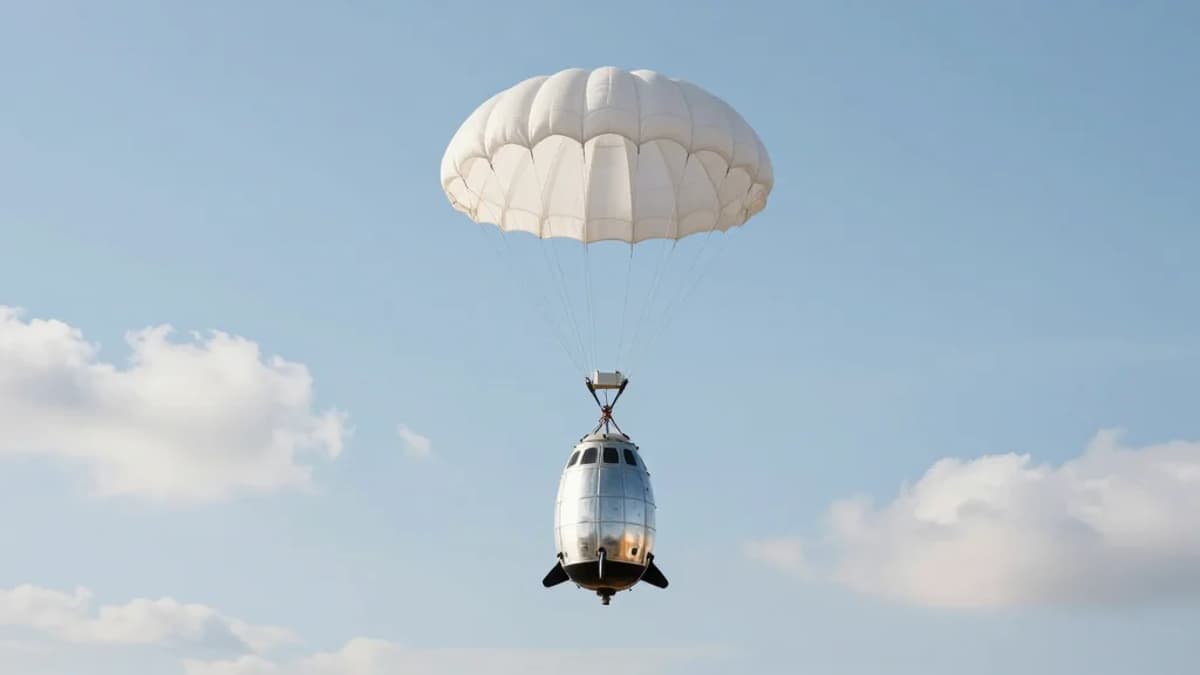
China Claims It Has Launched and Landed a New Suborbital Reusable Spacecraft
•January 13, 2026
0
Companies Mentioned

Why It Matters
The test signals China’s push to build a domestic suborbital market, potentially challenging U.S. players and expanding micro‑gravity services for research and tourism.
Key Takeaways
- •PH-1 reached 120 km, crossing Kármán line
- •Parachute deployed at 10 km, landing successful
- •Test validates re‑entry deceleration and precision landing
- •Capsule size limits manned flight potential
- •Signals China’s push into suborbital tourism market
Pulse Analysis
China’s aerospace sector has accelerated its suborbital program with the recent flight of the PH‑1 vehicle, developed by state‑backed CAS Space. By lofting a small reusable capsule to roughly 120 kilometres—well above the Kármán line—the test demonstrates the nation’s ability to produce a launch system that rivals early‑stage commercial efforts in the United States and Europe. The mission aligns with Beijing’s broader strategy to diversify its launch portfolio beyond orbital rockets, positioning reusable suborbital platforms as a stepping stone toward a domestic micro‑gravity services market.
The PH‑1 flight focused on three core technologies: high‑speed re‑entry deceleration, parachute‑assisted recovery, and precision landing control. After reaching space, the capsule re‑entered the atmosphere and deployed its parachute at about 10 kilometres altitude, touching down at a pre‑designated site without reported damage. Although no visual evidence of the recovered capsule has been released, the claimed success mirrors the operational profile of competitors such as Blue Origin’s New Shepard, which offers 100‑second weightless runs for research and tourism. The PH‑1’s 300‑second micro‑gravity window, however, remains modest compared with longer orbital missions.
If the technology proves reliable, CAS Space could commercialise short‑duration micro‑gravity flights for scientific experiments, materials testing, and potentially low‑cost astronaut training. A domestic suborbital service would reduce reliance on foreign providers and could feed into China’s longer‑term ambitions for crewed space tourism and rapid‑turnaround launch cycles. Nevertheless, scaling the capsule for human passengers will require larger, more complex vehicles and rigorous safety certifications, challenges that will test both engineering capacity and regulatory frameworks in the coming years.
China claims it has launched and landed a new suborbital reusable spacecraft
0
Comments
Want to join the conversation?
Loading comments...