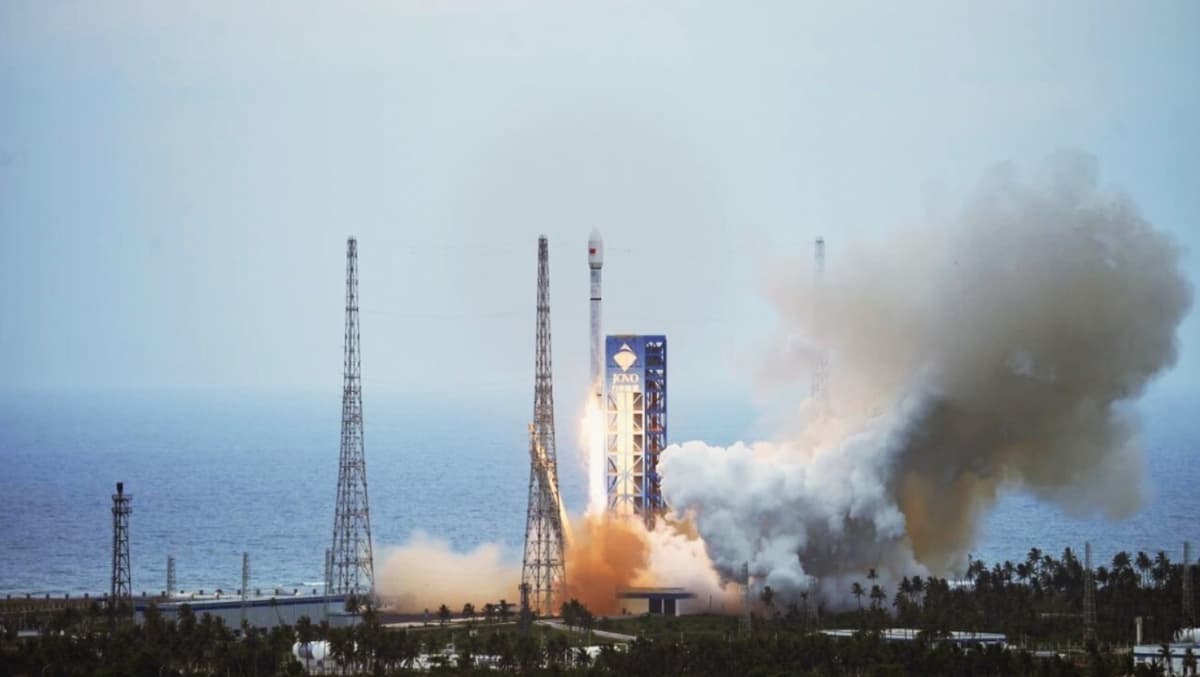
China Conducts 4 Launches in 3 Days, but Silence Follows Kuaizhou–11 Launch
Companies Mentioned
Why It Matters
The flurry of launches underscores China’s push to dominate low‑Earth‑orbit services and to prove its emerging private launch sector, while any failure could expose reliability gaps as the nation races toward a 100‑launch year.
Key Takeaways
- •China logged 43 launches in 2024, three failures, Kuaizhou‑11 status unclear.
- •Long March 12 placed 22nd Guowang batch, total 177 satellites in orbit.
- •Shijian‑31 entered Molniya orbit, marking Long March 3B return‑to‑flight.
- •Kinetica‑1 delivered eight Jilin‑1 remote‑sensing satellites, first private 100‑sat launch.
- •China aims >100 launches in 2026, developing reusable heavy‑lift rockets.
Pulse Analysis
China’s launch cadence is entering a new phase of intensity, with nine missions in June alone and a year‑to‑date total of 43 attempts. This surge reflects a strategic drive to secure orbital slots for commercial broadband constellations, military assets, and scientific experiments. By scaling both state‑run and private providers, Beijing aims to outpace rivals in the crowded low‑Earth‑orbit market, where capacity and price competitiveness are becoming decisive factors for satellite operators worldwide.
The recent Long March 12 flight added the 22nd group of Guowang broadband satellites, pushing the constellation to 177 units and illustrating China’s commitment to a 13,000‑satellite vision. Simultaneously, the Long March 3B’s successful deployment of Shijian‑31 into a Molniya orbit signals a return‑to‑flight after a January failure, restoring confidence in the workhorse vehicle that underpins many GEO missions. The silence surrounding the Kuaizhou‑11 launch, however, highlights lingering reliability concerns for smaller solid‑rocket providers, even as CAS Space’s Kinetica‑1 demonstrated private sector capability by delivering eight high‑resolution Earth‑observation payloads.
Looking ahead, China’s ambition to exceed 100 launches in 2026 hinges on advancing reusable heavy‑lift rockets such as the upcoming Long March 7A and Long March 8A. Success would not only cement Beijing’s position as the world’s most prolific launch nation but also reshape global supply chains, pressuring U.S. and European launch firms to accelerate their own reusability programs. For investors and industry watchers, the pace of China’s launch development offers a clear barometer of future market dynamics in satellite communications, remote sensing, and on‑orbit services.
China conducts 4 launches in 3 days, but silence follows Kuaizhou–11 launch
Comments
Want to join the conversation?
Loading comments...