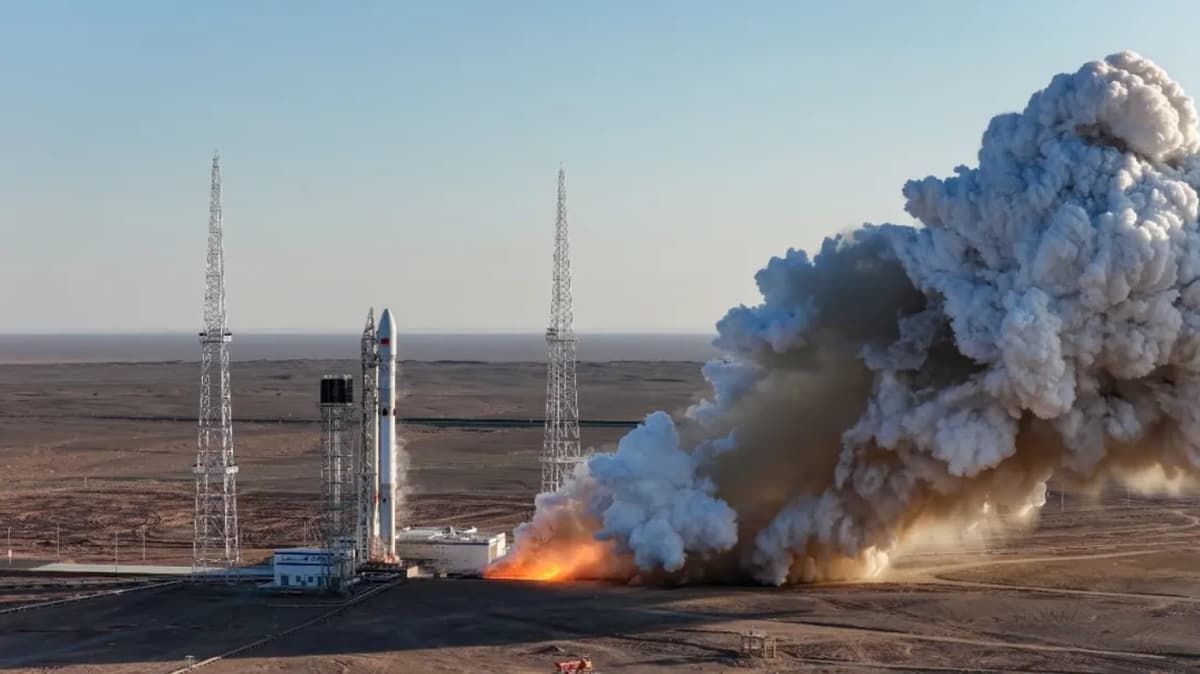
China Conducts Static Fire Test of New Reusable Long March 12B Rocket
•January 16, 2026
0
Companies Mentioned

Why It Matters
The test advances China’s effort to field medium‑lift reusable rockets, a capability critical for rapidly deploying its planned megaconstellations and competing globally in the satellite launch market.
Key Takeaways
- •Long March 12B completed static fire on Jan 16.
- •Rocket uses kerosene/LOX, 4‑meter diameter, 20‑ton LEO capacity.
- •Reusable first stage design mirrors Long March 12A efforts.
- •Test advances China’s push for medium‑lift reusable launchers.
- •Supports upcoming megaconstellation satellite deployments.
Pulse Analysis
The successful static‑fire of the Long March 12B on 16 January marks the latest milestone in China’s accelerated reusable‑launch programme. Conducted at the Dongfeng Commercial Space Innovation Test Zone, the test simulated the full pre‑launch sequence, including fueling, ignition and timing control, and demonstrated that the two‑stage vehicle can survive the stresses of a launch cycle. While the company released few technical specifics, the event follows the December orbital flight of the methane‑powered Long March 12A, underscoring a systematic approach to validating reusable hardware before committing to flight. The test also validated the vehicle’s ground‑support infrastructure.
The 12B diverges from its 12A sibling by switching to a kerosene‑liquid‑oxygen engine and expanding its diameter to four metres, a configuration the contractor describes as a “20‑ton‑class” LEO carrier. Although exact payload numbers for expendable and recovered modes remain undisclosed, the shift to kerosene suggests a focus on operational cost‑efficiency and rapid turnaround, traits essential for medium‑lift missions. Visuals hint at a reusable first‑stage architecture, yet landing‑leg hardware is not evident, indicating that propulsive descent and soft‑landing technologies are still under development.
Beyond the engineering milestone, the 12B is positioned to feed China’s ambitious megaconstellation projects such as Guowang and Qianfan, which together could exceed 200,000 satellites. A reliable, partially reusable launch vehicle would dramatically increase cadence and lower per‑kilogram costs, narrowing the gap with U.S. providers and private Chinese firms like Space Pioneer. With additional reusable rockets—Long March 10A/10B, Pallas‑1 and Tianlong‑3—scheduled for 2026, the industry is moving toward a high‑frequency launch ecosystem that could reshape global satellite services and reinforce China’s strategic foothold in low‑Earth orbit.
China conducts static fire test of new reusable Long March 12B rocket
0
Comments
Want to join the conversation?
Loading comments...