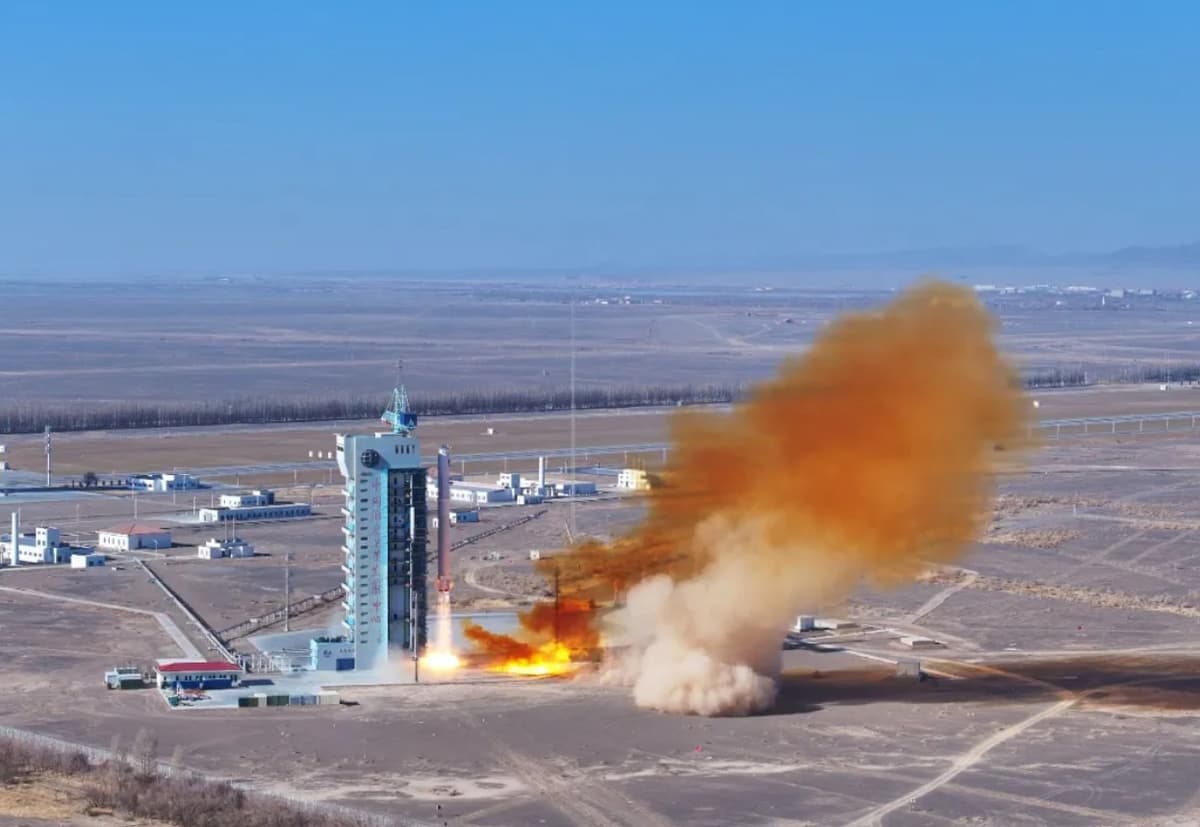
China Launches AlSat-3B for Algeria, Further Launches Delayed Ahead of Key Human Spaceflight Test
•January 31, 2026
0
Companies Mentioned

China Aerospace Science and Technology Corporation

China Academy of Space Technology

GalaxySpace

YouTube
Why It Matters
The mission showcases China’s expanding role in commercial satellite services while accelerating its crewed launch capabilities, reshaping the global launch market and geopolitical balance.
Key Takeaways
- •AlSat‑3B launched via Long March 2C, boosting Algerian imaging.
- •China targets over 100 orbital launches in 2026.
- •Long March 7A/8A delays follow Long March 3B failure.
- •Preparations underway for Long March 10 human‑flight test.
- •First Long March 12 mission deployed Guowang broadband constellation.
Pulse Analysis
China’s launch of AlSat‑3B marks a deepening partnership with Algeria, delivering high‑resolution Earth observation capacity that enhances the North African nation’s geospatial intelligence. Built by the China Academy of Space Technology, the satellite joins AlSat‑3A to form a dual‑satellite constellation, reflecting Beijing’s strategy of leveraging its mature launch infrastructure to secure export contracts. This commercial foothold not only diversifies revenue streams for CASC but also positions China as a reliable provider amid growing demand for high‑definition remote‑sensing data.
The broader launch cadence illustrates China’s ambition to become the world’s most prolific spacefaring nation. After 92 attempts in 2025, the goal of over 100 launches in 2026 signals confidence in its production lines and a push to dominate both government and commercial markets. Recent setbacks, including the Long March 3B third‑stage anomaly, have forced a temporary pause on the Long March 7A and 8A missions, highlighting the delicate balance between rapid launch turnover and technical reliability. Simultaneously, the successful deployment of the Guowang broadband megaconstellation via Long March 12 underscores China’s commitment to building indigenous communication networks.
Perhaps most consequential is the imminent test of the Long March 10 series, the cornerstone of China’s next‑generation crewed launch capability. Preparations at Wenchang for a low‑altitude or abort‑test of the Mengzhou crew capsule indicate a decisive step toward a full orbital flight later this year, potentially supporting Tiangong‑related missions or lunar endeavors. Success would cement China’s position alongside the United States and Russia in human spaceflight, while any further delays could ripple through its commercial launch schedule, affecting satellite customers worldwide.
China launches AlSat-3B for Algeria, further launches delayed ahead of key human spaceflight test
0
Comments
Want to join the conversation?
Loading comments...