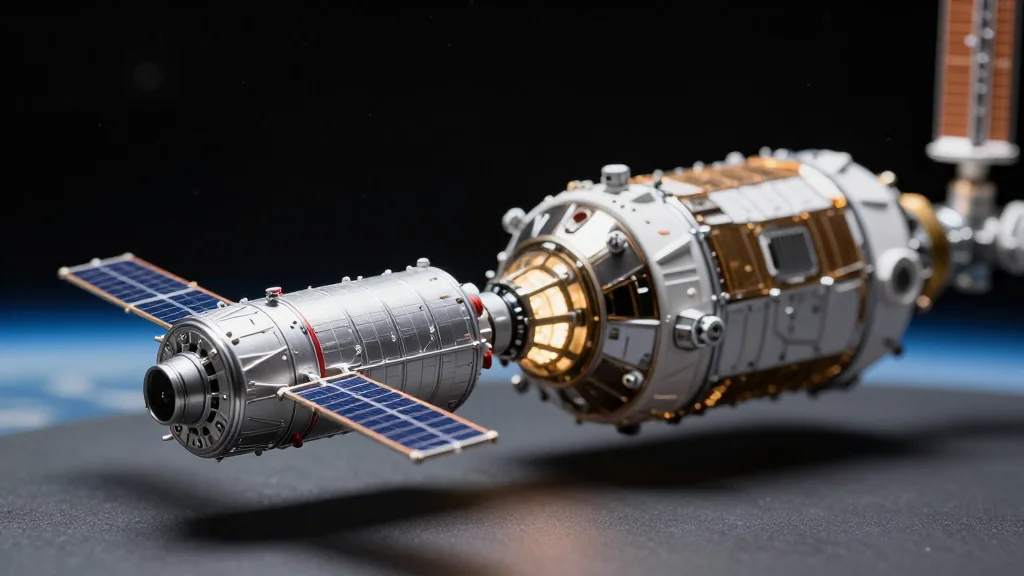
China Launches Tianzhou-10 Cargo Spacecraft to Resupply Tiangong Space Station

Why It Matters
Tianzhou-10's successful launch and docking cement China's ability to sustain a permanent crewed outpost without reliance on foreign supply chains, a capability that has strategic implications for national security and technological leadership. By demonstrating reliable autonomous resupply, Beijing positions Tiangong as a viable platform for international scientific cooperation, potentially attracting research partnerships from countries seeking alternatives to the aging ISS. The mission also signals a shift in the global space economy. As China builds a domestic logistics infrastructure, commercial launch providers in the United States and Europe may face increased competition for payload slots, prompting price adjustments and innovation in service offerings. Moreover, the demonstrated reliability of the Long March-7 Y11 could open doors for export-oriented launch services, further integrating China into the burgeoning low‑Earth‑orbit market.
Key Takeaways
- •May 11, 2026: Tianzhou-10 launched on a Long March-7 Y11 from Wenchang, Hainan
- •Docked with Tianhe core module of Tiangong, delivering several hundred kilograms of supplies
- •Mission underscores China's autonomous orbital logistics capability
- •Supports Tiangong's operational timeline through 2035 and beyond
- •Sets the stage for Tianzhou-11 and potential commercial resupply services
Pulse Analysis
China's Tianzhou-10 mission is less a headline-grabbing splash and more a quiet affirmation of a long‑term strategy: to own every link in the chain that keeps a crewed station alive. The Tianzhou series, modeled after Russia's Progress vehicle, has evolved into a workhorse that not only ferries consumables but also carries experiment hardware that can be transferred to the station's external platforms. This incremental capability building mirrors the approach taken by NASA in the early ISS era, where reliability was prized over spectacle.
From a market perspective, each successful Tianzhou flight chips away at the monopoly that U.S. commercial providers have held over ISS resupply. While the ISS remains operational, the United States is already planning its post‑ISS commercial low‑Earth‑orbit stations. China's demonstrated logistics chain could attract nations that are either excluded from U.S. programs or that seek a diversified portfolio of partners. The geopolitical undercurrent is clear: a self‑sufficient Tiangong reduces Beijing's vulnerability to sanctions or diplomatic pressure that could otherwise disrupt supply lines.
Looking forward, the real test will be whether China can translate this logistical competence into revenue‑generating services. If Tianzhou-11 and subsequent missions begin offering payload slots to foreign research teams or commercial customers, the global space logistics market could see a bifurcation—one side dominated by U.S. and European firms, the other by a rapidly maturing Chinese ecosystem. The next few years will reveal whether Tiangong becomes a hub for multinational science or remains a national showcase of engineering prowess.
China launches Tianzhou-10 cargo spacecraft to resupply Tiangong space station
Comments
Want to join the conversation?
Loading comments...