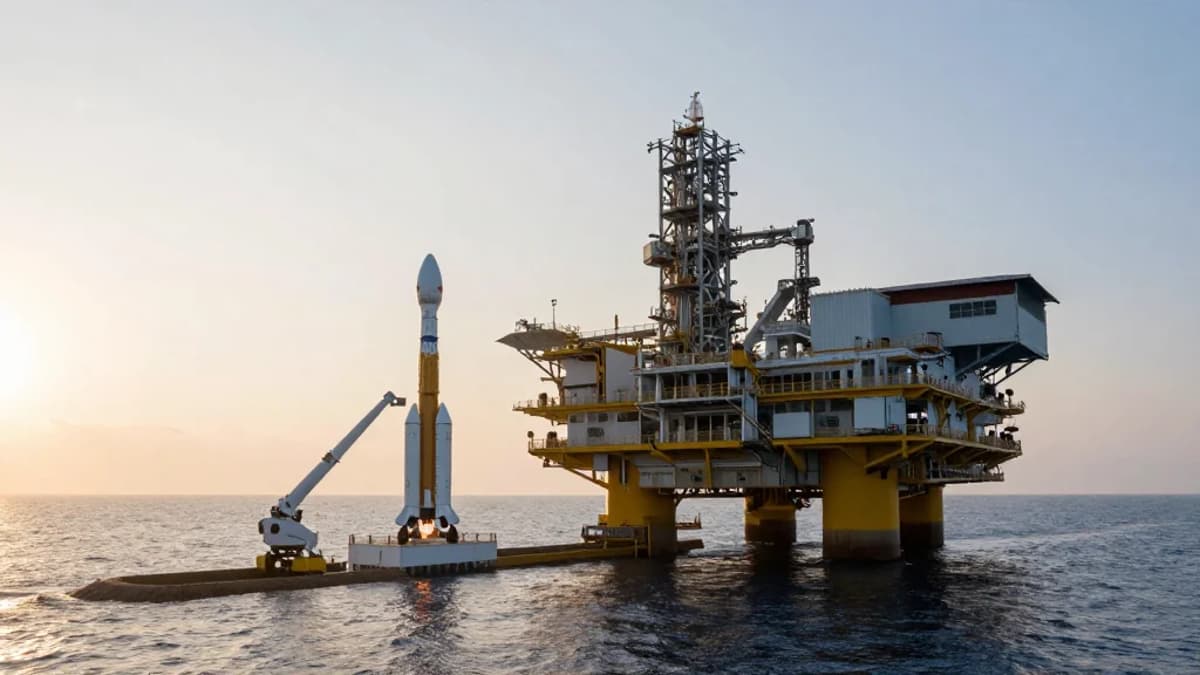
China Prepares Offshore Test Base for Reusable Liquid Rocket Launches
•January 26, 2026
0
Companies Mentioned

Why It Matters
Reusable liquid launch capability reduces per‑kilogram costs and strengthens China’s position in the global commercial space market, supporting the rapid growth of satellite constellations.
Key Takeaways
- •First Chinese offshore platform for reusable liquid rockets
- •Trial launches start early February 2026
- •Supports payloads heavier than solid-fuel launches
- •Enhances China's commercial launch share, 54% in 2025
- •Integrated propellant infrastructure enables rapid turnaround
Pulse Analysis
China’s decision to build an offshore launch platform dedicated to reusable liquid‑propellant rockets marks a clear shift from its historic reliance on solid‑fuel sea launches. Situated on an artificial island off Haiyang, the facility features a hydraulic erector, a deep flame trench and a water‑deluge system designed for rockets weighing several hundred tonnes. By moving launch operations to a maritime environment, China can sidestep land‑based constraints, test recovery procedures in a controlled setting, and align its hardware with the global move toward reusability pioneered by companies such as SpaceX.
The platform’s first trial, slated for early February 2026, aims to demonstrate vertical erection, engine ignition, and sea‑based recovery of a commercial liquid‑fuel vehicle. If successful, the capability could drive launch‑cost reductions of up to 30 percent per kilogram, a figure that would make Chinese services competitive for megaconstellation operators seeking rapid, low‑cost access. In 2025, commercial launches accounted for 54 percent of China’s total lift‑off activity and delivered 311 satellites, underscoring how reusable technology could expand that share and challenge incumbent Western providers.
Beyond the launch pad, the Haiyang complex integrates liquid‑oxygen, liquid‑nitrogen, kerosene and methane storage, enabling quick propellant turnaround and supporting multiple launch cycles per year. The development dovetails with Shandong’s broader aerospace cluster, linking manufacturers in Yantai, Jinan and Qingdao and feeding the national three‑year action plan (2025‑2027) that prioritises high‑quality commercial space growth. Analysts expect the offshore test base to become a proving ground for next‑generation reusable vehicles, potentially attracting foreign satellite customers and fostering joint ventures that accelerate China’s ascent in the global launch market.
China prepares offshore test base for reusable liquid rocket launches
0
Comments
Want to join the conversation?
Loading comments...