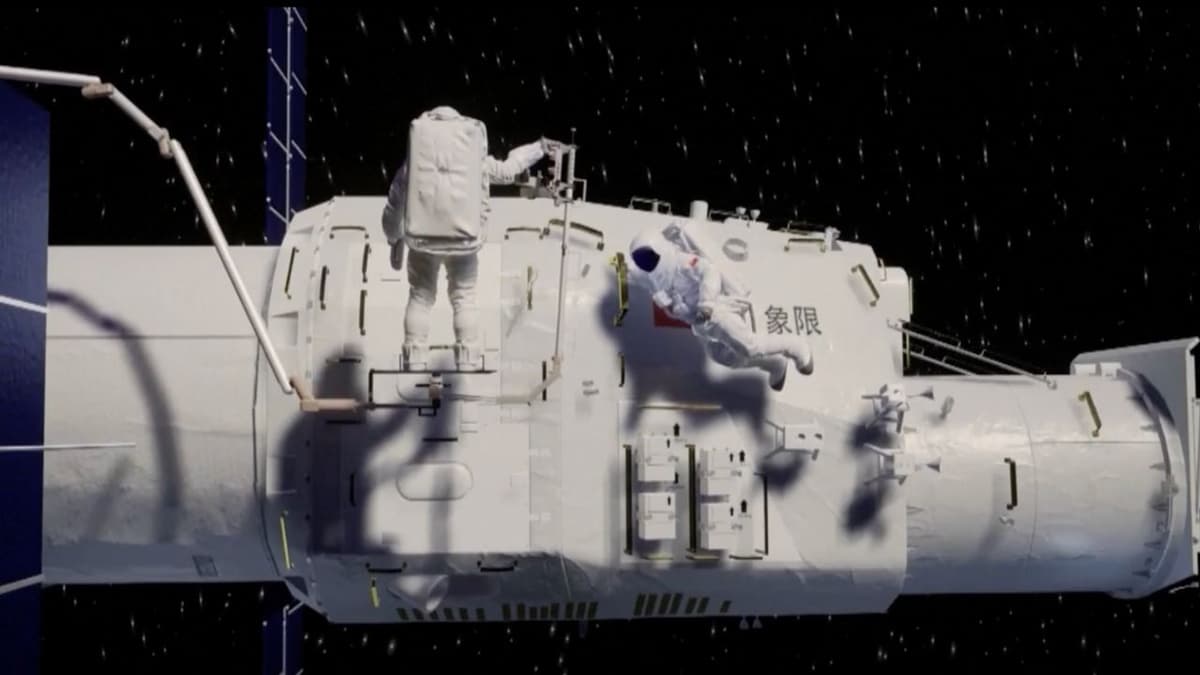
China Previews How Powerful Its New Xuntian Space Telescope Will Be Ahead of 2027 Launch (Video)
•January 19, 2026
0
Companies Mentioned

Why It Matters
Xuntian will dramatically accelerate sky surveys, giving China a leading role in cosmology and exoplanet research, while its serviceable architecture promises longer mission life than many peers.
Key Takeaways
- •Xuntian features 2‑meter mirror, smaller than Hubble
- •2.5‑billion‑pixel camera gives unprecedented resolution
- •Field of view 300× Hubble enables rapid sky surveys
- •Mock observation suite validates performance before 2027 launch
- •Docking with Tiangong enables astronaut servicing like Hubble
Pulse Analysis
Since the launch of its first space‑based observatory, China has pursued an increasingly ambitious astrophysics agenda. The Xuntian telescope represents the next logical step, bridging the gap between Hubble’s legacy and the forthcoming generation of large‑aperture survey instruments such as the Vera C. Rubin Observatory. By placing a 2‑meter primary mirror in a low‑Earth orbit that co‑habits with the Tiangong station, China can leverage existing ground‑segment infrastructure while avoiding the high‑cost deep‑space trajectories required by missions like James Webb. This positioning gives the nation a unique blend of accessibility and scientific reach.
The technical payload of Xuntian sets it apart. Its 2.5‑billion‑pixel focal plane delivers high‑resolution imaging across a field of view 300 times that of Hubble, enabling rapid, wide‑area surveys in ultraviolet, visible and near‑infrared bands. The recent mock‑observation suite, published in early January, reproduces expected instrumental noise, pointing jitter and detector characteristics, providing confidence that the telescope will meet its science objectives in cosmology, galaxy evolution and dark‑matter studies. Such pre‑launch validation shortens the risk window and accelerates data‑pipeline development for the international community.
Operationally, Xuntian’s ability to dock with Tiangong introduces a service model rarely seen outside NASA’s Hubble program. Astronauts can perform extravehicular repairs, upgrade instruments, or replace components, potentially extending the mission well beyond its nominal lifespan. This modular approach not only reduces long‑term costs but also signals China’s intent to establish a sustainable, in‑orbit scientific platform. As global competition intensifies, the telescope’s capabilities and serviceability could attract collaborative proposals, positioning China as a key data provider for next‑generation astrophysical research.
China previews how powerful its new Xuntian space telescope will be ahead of 2027 launch (video)
0
Comments
Want to join the conversation?
Loading comments...