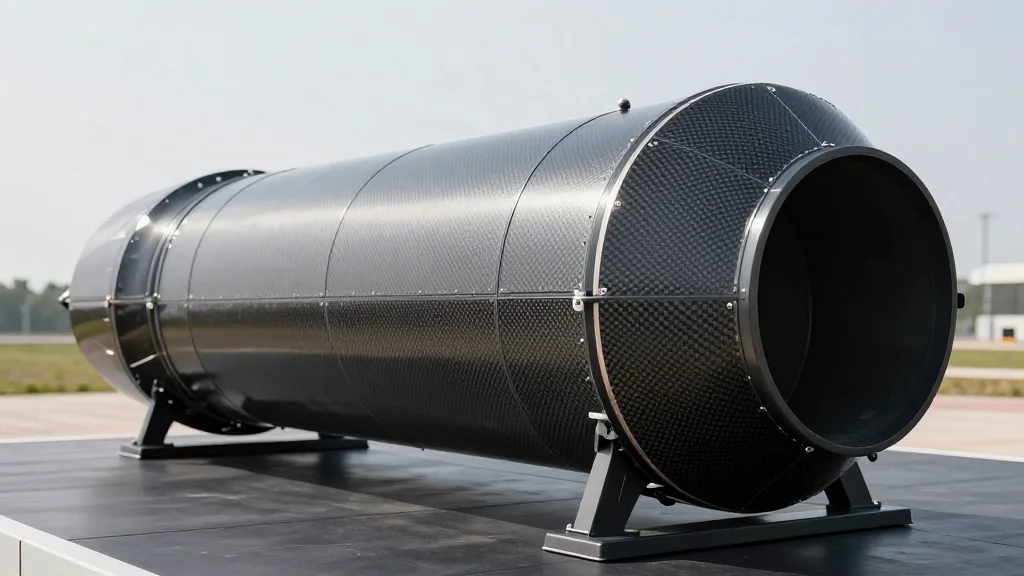
China's CASC Unveils 5‑Meter Composite Propulsion Module for Reusable Spacecraft

Companies Mentioned

Why It Matters
The module’s size, material composition, and rapid development timeline signal that China is closing the gap with Western and private-sector leaders in reusable launch technology. By embracing high‑percentage composites, CASC aims to cut launch mass and cost, directly influencing payload economics for both government and commercial missions. Moreover, the ability to iterate hardware in under eight months could accelerate China’s launch cadence, allowing it to capture a larger share of the international satellite‑deployment market. If the propulsion module proves reliable in flight, it will validate a manufacturing paradigm that could be replicated across other subsystems, from fairings to crew capsules. This would not only bolster China’s domestic space program but also enhance its credibility as a supplier of advanced space hardware to foreign partners, potentially reshaping global supply chains in the SpaceTech sector.
Key Takeaways
- •CASC’s First Academy delivered a 5‑meter‑diameter propulsion module, the largest integrated composite structure in China’s reusable launch fleet.
- •Composite material makes up over 60% of the module, targeting weight reduction and higher payload capacity.
- •Designed to withstand axial loads of up to 1,000 tonnes, meeting the demands of repeated launch cycles.
- •Development cycle completed in seven months, a notable acceleration over typical aerospace timelines.
- •Successful testing could see the module integrated into the Long March 9‑R demonstrator by 2027.
Pulse Analysis
China’s composite propulsion module is more than a technical showcase; it is a strategic lever in the nation’s broader ambition to dominate the reusable launch market. Historically, composite adoption in launch vehicles has been incremental, driven by the need to shave weight without compromising structural integrity. By achieving a 60% composite integration on a 5‑meter structure, CASC demonstrates that it can now produce large, monolithic composite components at a pace previously reserved for smaller, less critical parts.
The seven‑month development window is especially telling. In the commercial sector, rapid prototyping and iterative testing have become the norm, allowing firms like SpaceX to iterate designs within months. China’s ability to match—or even undercut—this speed suggests a maturing of its industrial base, including supply chain coordination, material certification, and digital manufacturing tools. This could reduce the time‑to‑market for future Chinese reusable boosters, narrowing the lead‑time advantage that private U.S. firms currently enjoy.
Market implications are immediate. Lower dry mass translates to higher payloads or reduced fuel requirements, both of which improve launch economics. If the module’s performance meets expectations, Chinese launch providers could offer more competitive pricing to international satellite operators, challenging the current dominance of U.S. and European launch services. Additionally, the modular, adaptive interface described in the source hints at a future where a single composite core can be reconfigured for multiple mission profiles, further enhancing cost efficiency.
Looking forward, the real test will be flight qualification. Successful static‑fire and orbital demonstrations will cement the module’s credibility and likely trigger a cascade of similar composite‑heavy designs across China’s launch architecture. Conversely, any failure could expose gaps in material testing or integration expertise, slowing the momentum. Either outcome will be a bellwether for how quickly China can translate manufacturing breakthroughs into operational advantage in the fiercely contested reusable launch arena.
China's CASC Unveils 5‑Meter Composite Propulsion Module for Reusable Spacecraft
Comments
Want to join the conversation?
Loading comments...