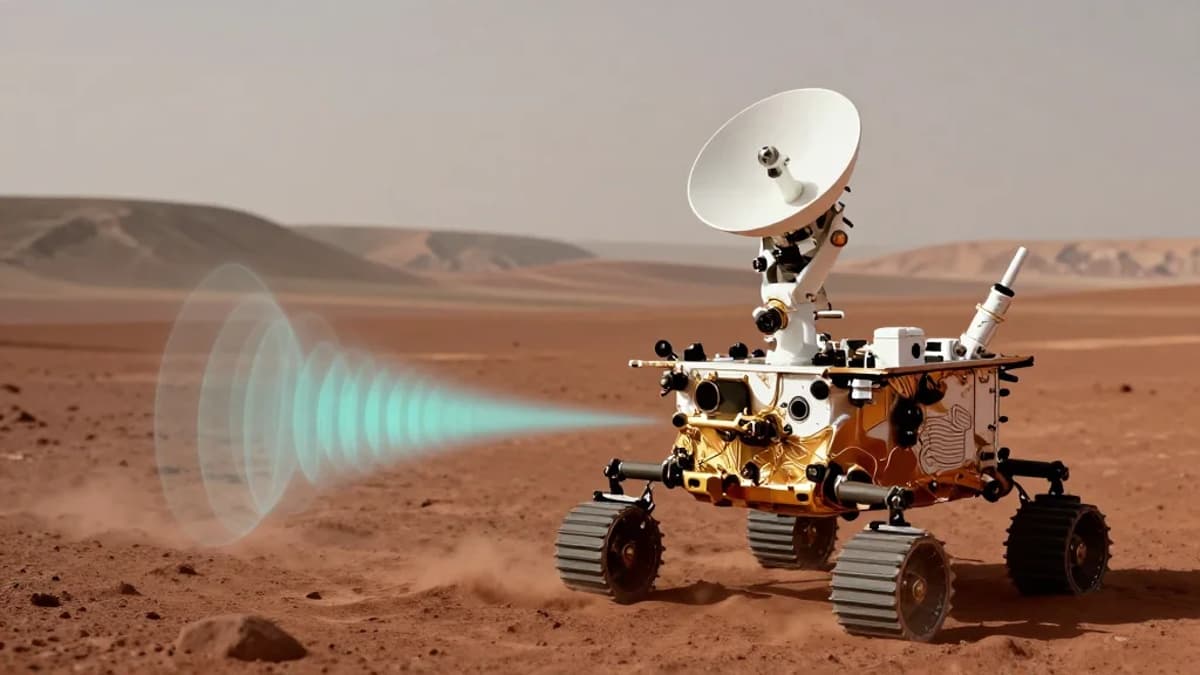
China’s Mars Rover: Radar Data Supports Shallow Subsurface Ice Find
•February 23, 2026
0
Why It Matters
Shallow ice at low latitudes offers a readily accessible water source for future human exploration, reducing logistical challenges for Mars missions. It also reshapes scientific understanding of volatile distribution on the Red Planet.
Key Takeaways
- •RoPeR radar detected ~7 m ice layer
- •Ice lies beneath two high‑loss strata
- •Ice depth ~15 m below surface
- •Discovery at low‑latitude Utopia Planitia
- •Potential resource for future crewed missions
Pulse Analysis
The detection of shallow subsurface ice by China’s Zhurong rover marks a pivotal shift in Mars exploration strategy. While prior missions, such as NASA’s Phoenix and Curiosity, focused on polar and mid‑latitude ice deposits, Zhurong’s radar data reveal a 7‑meter‑thick ice‑bearing layer beneath the southern Utopia Planitia plain. This region, previously prized for its geological signs of ancient water activity, now demonstrates that water ice can persist at depths of 15 meters even in relatively low‑latitude zones, challenging earlier models that confined stable ice to higher latitudes.
From an operational perspective, the presence of near‑surface ice dramatically lowers the cost and complexity of in‑situ resource utilization (ISRU) for crewed missions. Extracting water for life support, fuel production, and radiation shielding becomes feasible without the need for deep drilling rigs. The discovery aligns with international plans to establish a sustainable human foothold on Mars, where water extraction is a critical prerequisite. Moreover, the data enrich planetary scientists’ understanding of Mars’ climatic evolution, indicating that volatile reservoirs may be more widespread than previously thought.
Scientifically, the RoPeR findings underscore the value of ground‑penetrating radar in planetary geology. By integrating radar signatures with surface imaging from orbiters like NASA’s MRO, researchers can map subsurface composition with unprecedented precision. The study, led by Xindong Meng, also highlights China’s growing competence in deep‑space instrumentation and data analysis. As the global community prepares for the next wave of Mars missions, the Zhurong ice discovery will likely influence landing site selection, mission architecture, and collaborative research agendas.
China’s Mars Rover: Radar Data Supports Shallow Subsurface Ice Find
0
Comments
Want to join the conversation?
Loading comments...