Why It Matters
The enhanced view helps scientists refine models of jet disruption and storm formation on gas giants, informing both Solar System and exoplanet studies. It also demonstrates how public contributions can accelerate data interpretation for high‑profile NASA missions.
Key Takeaways
- •Juno's 61st flyby captured high‑resolution data of Jupiter's north pole
- •Citizen scientist processed raw JunoCam images to reveal vivid cloud turbulence
- •Folded filamentary region shows jet breakdown, causing rapid storm evolution
- •Visuals aid researchers in refining models of gas‑giant atmospheric behavior
- •Public participation speeds scientific analysis and broadens outreach
Pulse Analysis
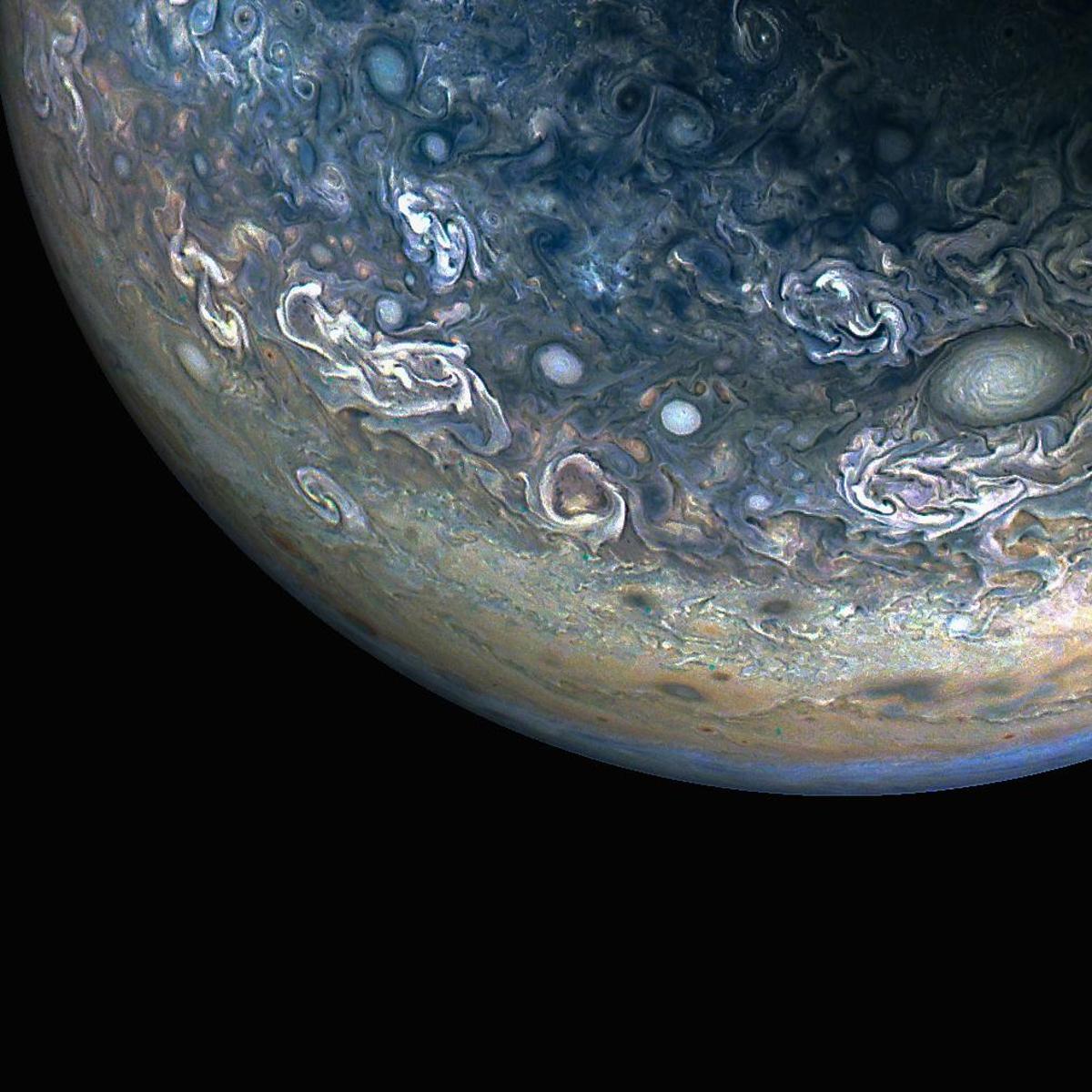
The Juno spacecraft, now in its eighth year orbiting Jupiter, continues to deliver unprecedented close‑up observations. During its 61st perijove on May 12, 2024, JunoCam recorded raw visual data of the planet’s northern hemisphere at a resolution previously unattainable from Earth‑based telescopes. While NASA scientists routinely analyze these datasets, the image that gained headlines was assembled by Gary Eason, a citizen scientist who applied advanced color‑enhancement algorithms to bring out subtle cloud features. This collaboration highlights how public contributors can transform mission archives into striking scientific assets.
The processed view focuses on a folded filamentary region where Jupiter’s iconic banded jets disintegrate into chaotic vortices. In this zone, zonal winds lose their coherence, allowing cyclonic storms to merge and evolve on timescales of days rather than weeks. Understanding how these jet‑breakdown processes operate is critical for refining fluid‑dynamic models that describe not only Jupiter but also other gas giants and rapidly rotating exoplanets. The high‑contrast imagery offers researchers a rare laboratory to test turbulence theories against real‑world planetary data.
Beyond its scientific merit, the image underscores the expanding role of citizen science in planetary exploration. Platforms such as NASA’s citizen‑science portal enable volunteers to access raw telemetry, apply custom processing pipelines, and contribute findings that can be cited in peer‑reviewed studies. This democratization accelerates data turnaround, reduces bottlenecks in image interpretation, and cultivates a broader public appreciation for space research. As future missions to Europa, Ganymede and Saturn’s moons generate petabytes of visual data, crowdsourced analysis will likely become an essential component of mission success.
Colorful, Chaotic Jupiter
Comments
Want to join the conversation?
Loading comments...