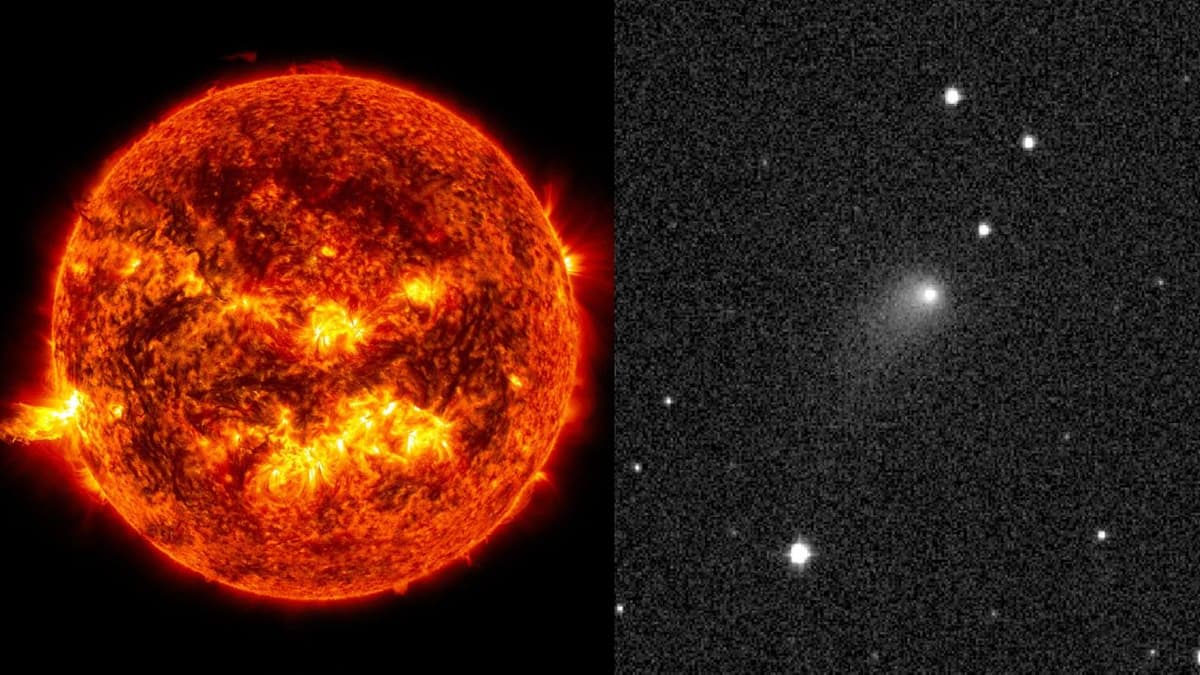
Comet Wierzchos Buzzes the Sun Later Today: But Can You See It?
•January 20, 2026
0
Why It Matters
The perihelion event offers a rare opportunity for amateur astronomers to study a dynamically new Oort‑cloud comet, while JWST’s compositional data enhances our understanding of early solar‑system material.
Key Takeaways
- •Perihelion today at 52.6 million miles from Sun.
- •Peak brightness +8.1 magnitude, beyond naked‑eye limit.
- •Visible with small telescope in southern constellation Microscopium.
- •Perigee Feb 17, 93 million miles, magnitude +8.9.
- •JWST found comet lacks cobalt, indicating Oort Cloud origin.
Pulse Analysis
The January 20 perihelion of comet C/2024 E1 (Wierzchos) creates a fleeting window for skywatchers across the Southern Hemisphere. At a distance of 52.6 million miles, solar radiation vaporizes the icy nucleus, forming a bright coma and tail that push the object to roughly +8.1 magnitude. While the comet remains invisible to the naked eye, a modest backyard telescope or quality binoculars can reveal its structure, especially when it traverses the faint constellation Microscopium before sinking below the horizon for most U.S. observers.
Beyond its visual appeal, Wierzchos serves as a scientific probe of primordial solar‑system material. The James Webb Space Telescope’s spectroscopic analysis detected an unexpected deficiency of cobalt, a trace element that can be stripped during early planetary migration. This compositional clue reinforces the comet’s Oort Cloud provenance, offering researchers a rare glimpse into the chemical inventory of the solar system’s outermost reservoir. Understanding such elemental anomalies helps refine models of planetary formation and the delivery of volatiles to early Earth.
Looking ahead, the comet’s February 17 perigee—when it passes within 93 million miles of Earth—will present another observation chance, albeit at a slightly fainter +8.9 magnitude low on the southwestern horizon. Amateur astronomers equipped with DSLR cameras and fast lenses can capture long‑exposure images of the tail, contributing valuable data to citizen‑science platforms. As interest in astrophotography grows, events like Wierzchos underscore the market demand for portable, high‑quality telescopes and imaging accessories, while also highlighting the collaborative potential between professionals and hobbyists in tracking transient celestial phenomena.
Comet Wierzchos buzzes the sun later today: But can you see it?
0
Comments
Want to join the conversation?
Loading comments...