Comparing US and Canadian Space Launch Regulations: A Path to Sovereign Orbital Access
Companies Mentioned

Why It Matters
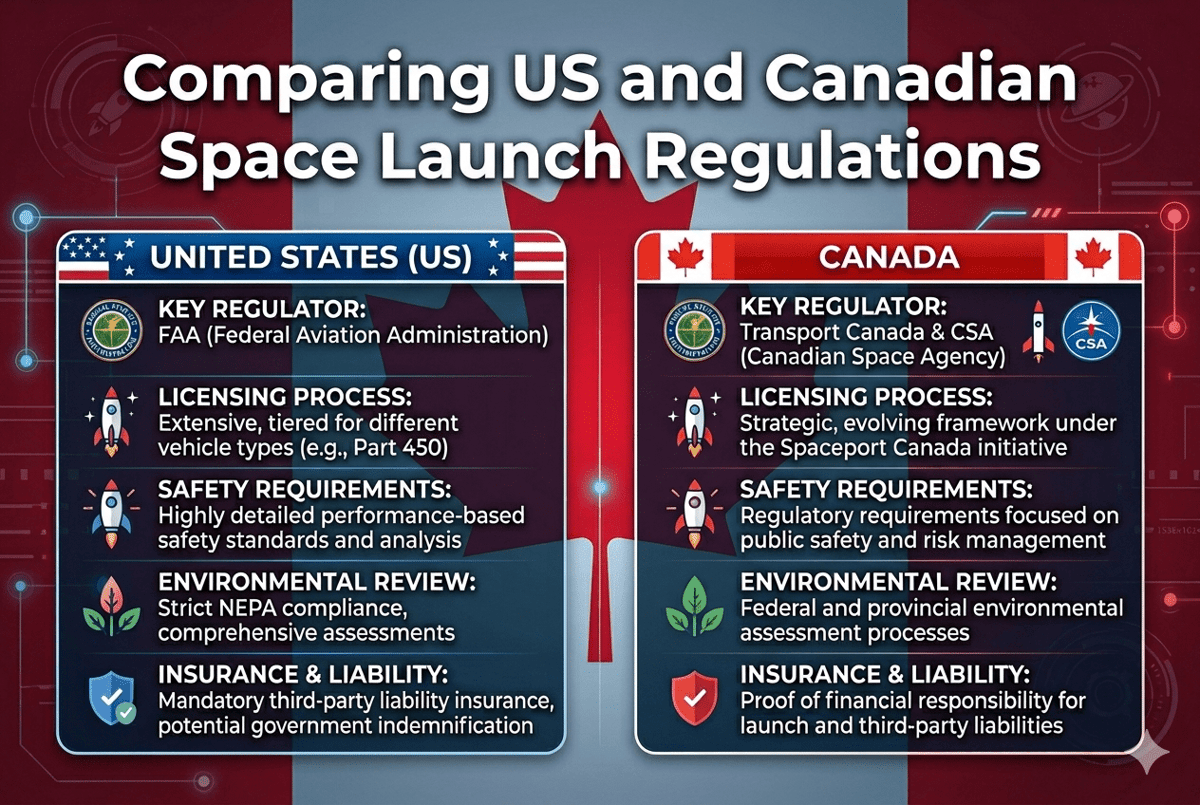
Aligning Canada’s regulations with the FAA reduces barriers for U.S. technology use and accelerates the development of a home‑grown launch industry, enhancing North‑American strategic resilience. It also offers U.S. operators an additional, interoperable launch venue, diversifying supply chains.
Key Takeaways
- •Canada’s Space Launch Act mirrors FAA’s Part 450 licensing model.
- •U.S. FAA now uses a single performance‑based rule for all launches.
- •Canada aims for first domestic launches within 2‑3 years after passage.
- •Harmonized regulations ease technology transfer under the US‑Canada safeguards pact.
Pulse Analysis
The United States has spent four decades refining a risk‑based licensing regime that culminated in the 2026 rollout of 14 CFR Part 450. By consolidating multiple legacy permits into a single performance‑oriented license, the FAA cuts approval times to as little as 180 days while maintaining stringent safety, environmental, and financial safeguards. This streamlined approach has underpinned more than 1,000 commercial launches, cementing America’s position as the global leader in orbital access and providing a template for emerging space nations.
Canada’s newly enacted Space Launch Act marks a decisive shift from ad‑hoc aeronautics‑based approvals to a dedicated statutory framework. Drafted to mirror the FAA’s Part 450, the act codifies safety analyses, insurance requirements, and inter‑agency reviews while embedding the bilateral Technology Safeguards Agreement that eases the flow of U.S. components under ITAR rules. The legislation promises regulatory certainty, attracting private capital, fostering domestic launch‑site development, and creating high‑skill jobs in a market that has so far relied on foreign providers.
Strategically, the convergence of U.S. and Canadian regulations strengthens the North‑American space supply chain, reducing single‑point vulnerabilities and expanding launch capacity for allied missions. For U.S. firms, a Canadian launch corridor offers a low‑risk, familiar regulatory environment, potentially easing congestion at busy U.S. spaceports. For Canada, the alignment accelerates industry bootstrapping, positioning the country as a sovereign launch provider and a reliable partner in an increasingly contested orbital domain. The combined ecosystem could drive innovation, lower costs, and secure long‑term access to space for both nations.
Comparing US and Canadian Space Launch Regulations: A Path to Sovereign Orbital Access
Comments
Want to join the conversation?
Loading comments...