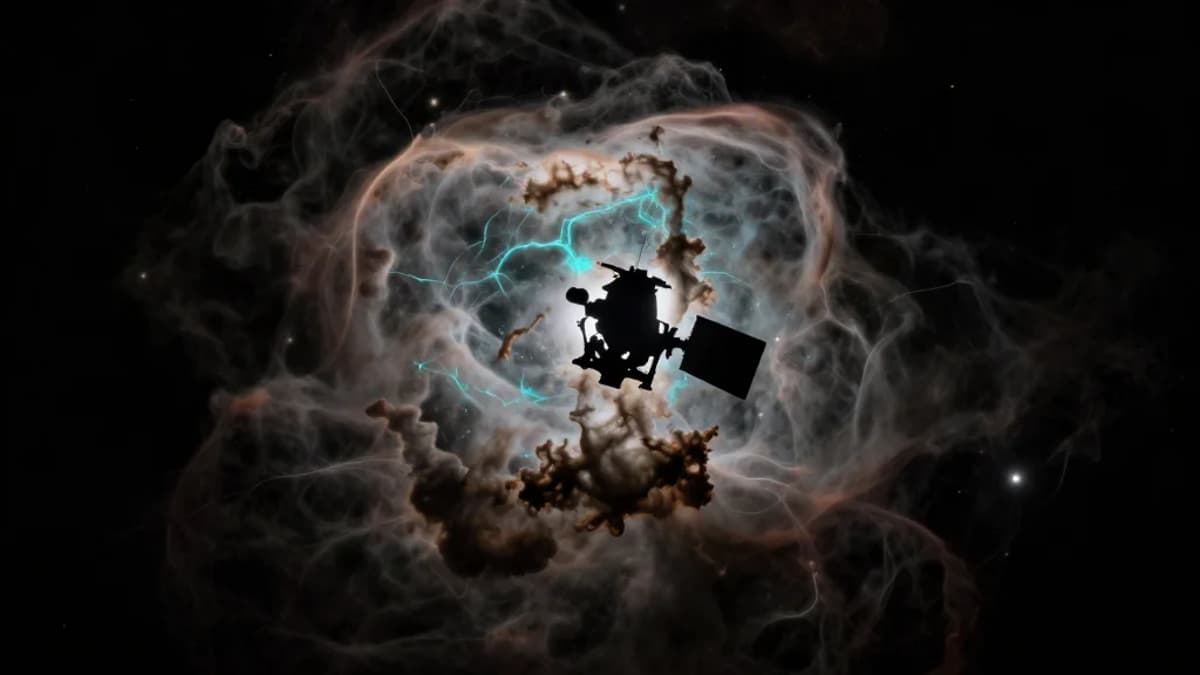
Cosmic Radiation Brought to Light: Researchers Measure Ionization in Dark Cloud for the First Time
•February 3, 2026
0
Why It Matters
Directly measuring the cosmic‑ray ionization rate eliminates model‑dependent uncertainties, sharpening our understanding of the chemical pathways that govern star and planet formation.
Key Takeaways
- •JWST detected three faint H₂ infrared lines in Barnard 68.
- •First direct measurement of cosmic‑ray ionization rate.
- •Prior estimates relied on indirect chemical tracers.
- •Findings refine models of star‑forming cloud chemistry.
- •Future JWST observations will target additional dark clouds.
Pulse Analysis
Cosmic rays, high‑energy particles that permeate the galaxy, have long been recognized as a hidden engine of interstellar chemistry. In the cold interiors of molecular clouds, where starlight cannot penetrate, these particles ionize molecular hydrogen, setting off reaction chains that build complex organic molecules. Historically, astronomers inferred the ionization rate indirectly, using scarce molecular ions as proxies and relying on models with many uncertain parameters. The advent of JWST’s ultra‑sensitive infrared spectrograph now enables astronomers to observe the faint glow produced when cosmic rays directly excite H₂, offering a cleaner diagnostic.
Targeting Barnard 68—a nearby, dense, and exceptionally cold cloud—the research team pointed JWST’s spectrometer at the cloud’s opaque core and captured three predicted infrared lines of molecular hydrogen. The detection matches theoretical expectations that have existed for decades, confirming that cosmic rays can be observed stimulating gas directly. By measuring the intensity of these lines, the team derived an empirical cosmic‑ray ionization rate, bypassing the need for indirect chemical proxies and reducing the error margins that have plagued previous studies.
The ability to directly quantify cosmic‑ray ionization reshapes our grasp of star‑forming environments. Accurate ionization rates feed into astrochemical networks, improving predictions of molecule formation, thermal balance, and ultimately the conditions that lead to planet formation. Moreover, the method opens a new observational window for probing the energetic particle environment across diverse interstellar settings. Planned JWST campaigns will apply this technique to other dark clouds, building a statistical picture that could refine galaxy‑scale models of cosmic‑ray propagation and its feedback on the molecular universe.
Cosmic radiation brought to light: Researchers measure ionization in dark cloud for the first time
0
Comments
Want to join the conversation?
Loading comments...