Why It Matters
The morphology suggests that Mars’ ancient water systems left lasting geological signatures, informing models of planetary climate evolution and guiding future landing‑site selections for rovers seeking biosignatures.
Key Takeaways
- •Flat‑rim crater deviates from typical impact morphology.
- •Cracked mesas suggest ancient desiccated sediment.
- •Mawrth Vallis once likely channeled water or glacial melt.
- •Site considered for Franklin rover, now excluded.
Pulse Analysis
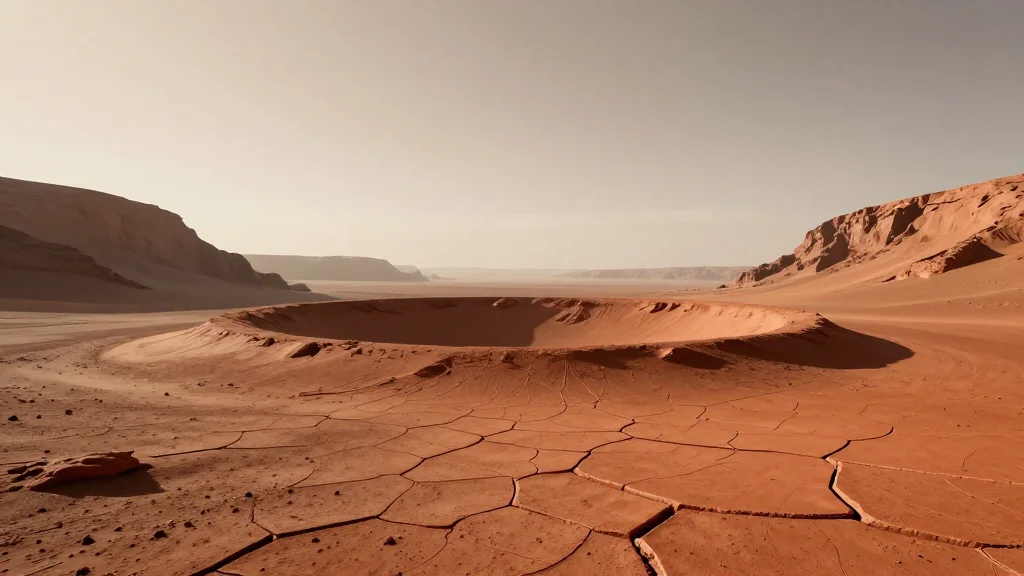
The newly released MRO snapshot captures a strikingly flat‑rimmed crater in Mawrth Vallis, a departure from the raised rims typical of impact sites. Flanking the crater are two modest mesas, each rising 15‑20 meters, encircled by a web of fissures that mirror the drying cracks seen in terrestrial mudflats. This visual evidence reinforces the notion that the region has been arid for millions of years, with surface processes now dominated by thermal contraction and dust accumulation rather than active geology.
Mawrth Vallis has long intrigued scientists because its 640‑kilometer channel likely served as a conduit for water or glacial melt flowing from the southern highlands toward the ancient northern ocean. Sedimentary layers exposed in the valley preserve mineralogical clues—such as phyllosilicates—that point to prolonged aqueous alteration. The cracked terrain adds a new dimension, suggesting that after the water receded, the exposed sediments underwent desiccation, creating a brittle crust prone to cracking under temperature swings. These observations help refine models of Mars’ climatic transition from a wetter past to the cold, dry world observed today.
From an exploration standpoint, the site’s geological complexity makes it both a scientific treasure and a logistical challenge. While Mawrth Vallis was once a candidate for ESA’s Franklin rover, the presence of uneven mesas and extensive cracking raised concerns about rover stability and navigation. Nonetheless, the region remains a prime target for future missions seeking to sample ancient sediments that could hold biosignature evidence. Understanding the interplay between past water flow and present‑day surface fragility will be crucial for designing landers and rovers capable of safely traversing Mars’ most promising yet precarious terrains.
Cracked bedrock on Mars?
Comments
Want to join the conversation?
Loading comments...