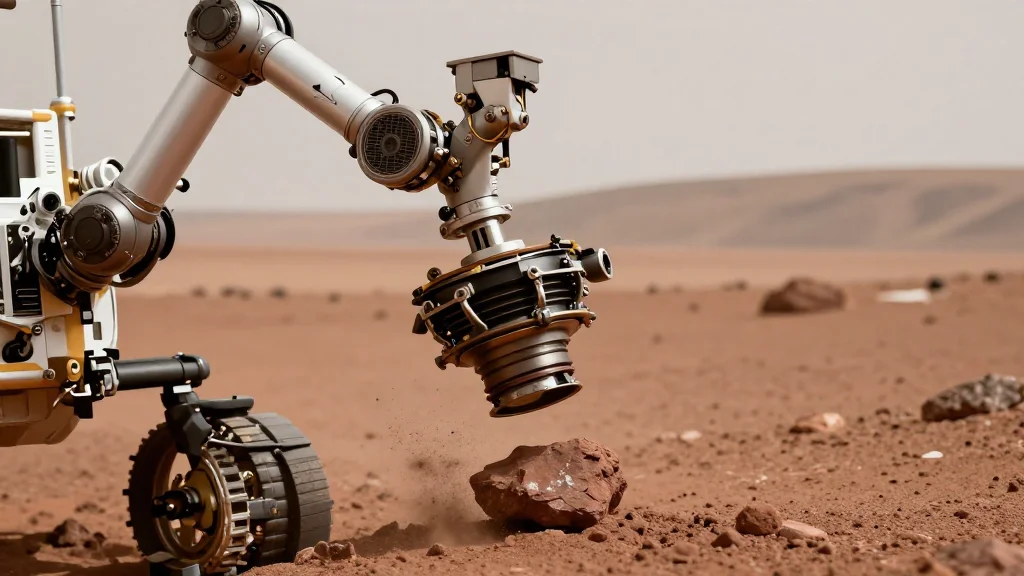
Curiosity Mars Rover: Struggle at Atacama
Companies Mentioned


Why It Matters
Recovering the drill restores Curiosity’s ability to acquire subsurface samples, crucial for understanding Mars’ habitability and guiding future sample‑return missions.
Key Takeaways
- •Curiosity’s drill bit stuck in Atacama rock block
- •Engineers used re‑orientation, vibration, and percussion to free it
- •Rock weighed ~28.6 lb and lifted with the drill sleeve
- •First time a rock remained attached to the drill sleeve
- •Mission now seeks firmly rooted targets for sample collection
Pulse Analysis
The Atacama incident highlights the mechanical complexities of planetary drilling. Curiosity’s robotic arm must contend with unpredictable rock cohesion, especially on a planet where gravity is only 38 % of Earth’s. Engineers leveraged a combination of arm articulation, rotational torque, and percussion‑driving—techniques honed from previous Mars missions—to overcome a scenario never encountered before. This problem‑solving episode underscores the importance of adaptable hardware and real‑time decision‑making in deep‑space exploration.
Beyond the immediate engineering triumph, freeing the drill has scientific implications. The Atacama target was selected for its similarity to Earth’s hyper‑arid Atacama Desert, a proxy for ancient Martian environments. Although the original sample was lost when the rock detached, the episode provides valuable data on rock strength, fracture mechanics, and dust dynamics on Mars. Such insights refine models used to predict drilling success, informing the design of upcoming missions like the Mars Sample Return campaign, which will rely on precise subsurface extraction.
Looking ahead, NASA’s rover teams are prioritizing “firmly rooted” drill sites to ensure sample integrity and maximize scientific return. The experience also feeds into the engineering roadmap for future rovers and human habitats, where reliable excavation will be essential for resource utilization. By documenting the challenge and solution, Curiosity contributes to a growing knowledge base that reduces risk for the next generation of Mars explorers, reinforcing the United States’ leadership in planetary science.
Curiosity Mars Rover: Struggle at Atacama
Comments
Want to join the conversation?
Loading comments...